
Elderflower Cordial Recipe – How to Make and Can Fragrant Elderflower Syrup
Why Make Elderflower Cordial?
This year I made elderflower cordial for the very first time. My only frame of reference before was the bottled version from Ikea – not bad, but also nothing special. What changed things for me was going for walks in late spring and realizing the incredible fragrance drifting through the air came from elderflower blossoms. Sweet, herbal, not quite like anything else I knew. I thought, if homemade cordial tastes anything like this, it has to be amazing.
I don’t usually drink sweet things – I’m a water drinker through and through – so making a syrup felt like a waste of time. But I’m so glad I did, and I wish I’d made more. We mix it with sparkling water and a few frozen strawberries to make a perfect non-alcoholic aperitif when friends come over. Light, refreshing, and floral in a way you just can’t get from the store.
Elderflower Cordial
Ingredients
- 20 clusters Elderflower blossoms
- 1 liter Water (about 4 cups)
- 1 kg Sugar (about 2¼ lb / about 5 cups)
- 1 Lemon (organic or untreated, washed)
- 2 tbsp Citric acid powder
Units: metric first, with a US equivalent in brackets. Weight-to-weight and temperature conversions are exact; volume equivalents for chopped or packed ingredients are approximate. The German headspace and the vinegar quantity are kept as measured (safety-load values).
Method
- Harvest and prepare the flowers and gather your other ingredients. Pick the elderflower heads on a dry, sunny day when they’re most fragrant. Gently shake off insects and remove any browned blossoms. Avoid washing them, as that can rinse away the aroma.
- Make the sugar syrup: In a large pot, bring the water, sugar, and citric acid to a boil. Turn off heat.
- Place the elderflowers in the syrup along with the lemon slices. Stir gently to submerge everything.
- Cover the container with a lid let the mixture steep in a cool place for 24–72 hours. Stir once or twice if you like.
- Strain the cordial through a sieve, cheesecloth, or nut milk bag into a clean pot.
- For a clearer cordial, strain again through a fine mesh sieve.
- Bring the strained cordial to a boil in a large pot.
- Carefully ladle the hot cordial into clean, hot jars, leaving appropriate headspace. Wipe the rims clean, apply lids, seals, and clamps and close securely.
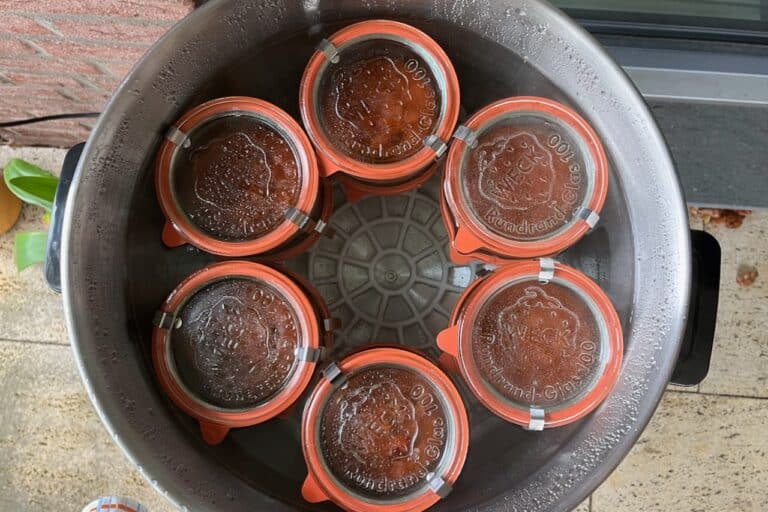
- Process in water bath: Place the jars in the already hot water bath canner and heat to 90 °C (194 °F). Once the temperature is reached, start timing and process for 30 minutes at 90 °C (194 °F). Then turn off the heat and let the jars rest in the water for 5–10 minutes.
- Carefully remove the jars and place them on a towel or wooden surface. Let them cool undisturbed for 24 hours. After that time, remove the metal clamps and check the seals. Label the jars and store them in a cool, dark place.
- Serving suggestion: Dilute to taste with water or sparkling water, or use in cocktails, spritzers, and desserts.
Free 7-lesson course + newsletter
Canning Science Foundations
Seven short lessons on the biology behind home canning: why the rules exist, what actually keeps food safe, and how to look at any recipe and see where the safety lives (no chemistry degree required). Finish them and you stay on for the newsletter: seasonal harvests, kitchen experiments, and the science behind each one.

Julie Kaiser is a molecular biologist and science writer who has lived in Germany since 2011. She spent over a decade in virology and national security research labs before becoming a professional science writer. She came to German water bath canning the way scientists come to most things: by reading the primary sources and deciding the evidence held up. Old World Preserves is where she writes about what she’s learned and what she’s growing, cooking, and preserving in her Lower Rhine garden.