
Canning in Weck jars: my workflow, tips, and tricks
A step-by-step guide to prepping, filling, sealing, and checking Weck jars – with the techniques German home canners actually use.
I’m Julie Kaiser – a molecular biologist and home canner on Germany’s Lower Rhine – and I switched to Weck jars for canning after moving to Germany, and have never looked back. They’re durable, reusable, and easy to inspect for a proper seal. In this post, I walk through exactly how to can with Weck jars, including how to prep the jars and rings, seat the lids correctly, clamp them without chipping, and safely load and unload your canner.
Just for the record: I’m not affiliated with Weck, and I don’t make any money from writing about their jars. I just really like using them, and this post reflects my honest, unpaid opinion.
- My switch to Weck jars
- Prepping the Weck jars, lids, and rubber rings
- Filling Weck jars to the right headspace
- Putting on the Weck rubber rings lid clamps
- Loading Weck jars into the canner
- Removing Weck jars from the canner without disrupting the seal
- Checking to see if the Weck jars are sealed
- Storing and using Weck jars of home-canned food
- Advantages of canning with Weck jars
- FAQs about canning food in Weck jars
My switch to Weck jars
When I moved to Germany and started canning again, I bought some jars with two-piece Mason-style lids. They worked, but they didn’t stack and were fumbly in my kitchen cabinets. I realized that most people in my local canning forums use modern Weck jars or older-style glass jars with glass lids, so I decided to try them out.
Curious about how German water bath canning works? Start with my overview of the method and why it’s trusted by generations of home canners.
I’ll admit, they were a little fussy at first: getting the rubber ring on just right, placing the lid without the rubber ring falling off, putting the clips on without chipping the glass. But I’ve learned a few tricks that make the whole process smoother, and at this point, I actually prefer Weck jars. Now I use them for nearly everything I can, with a few exceptions.
Prepping the Weck jars, lids, and rubber rings
When I’m getting ready to can something, I bring up the jars and lids I’ll need from our basement. I always hand-wash them with hot, soapy water. Our basement is a little damp, and I want to remove any mold spores that might be on the glass. I don’t use the dishwasher, because our water is extremely chalky, and our dishwasher has a built-in softening system, so the water isn’t “pure”. I also wash the lids and rubber rings.
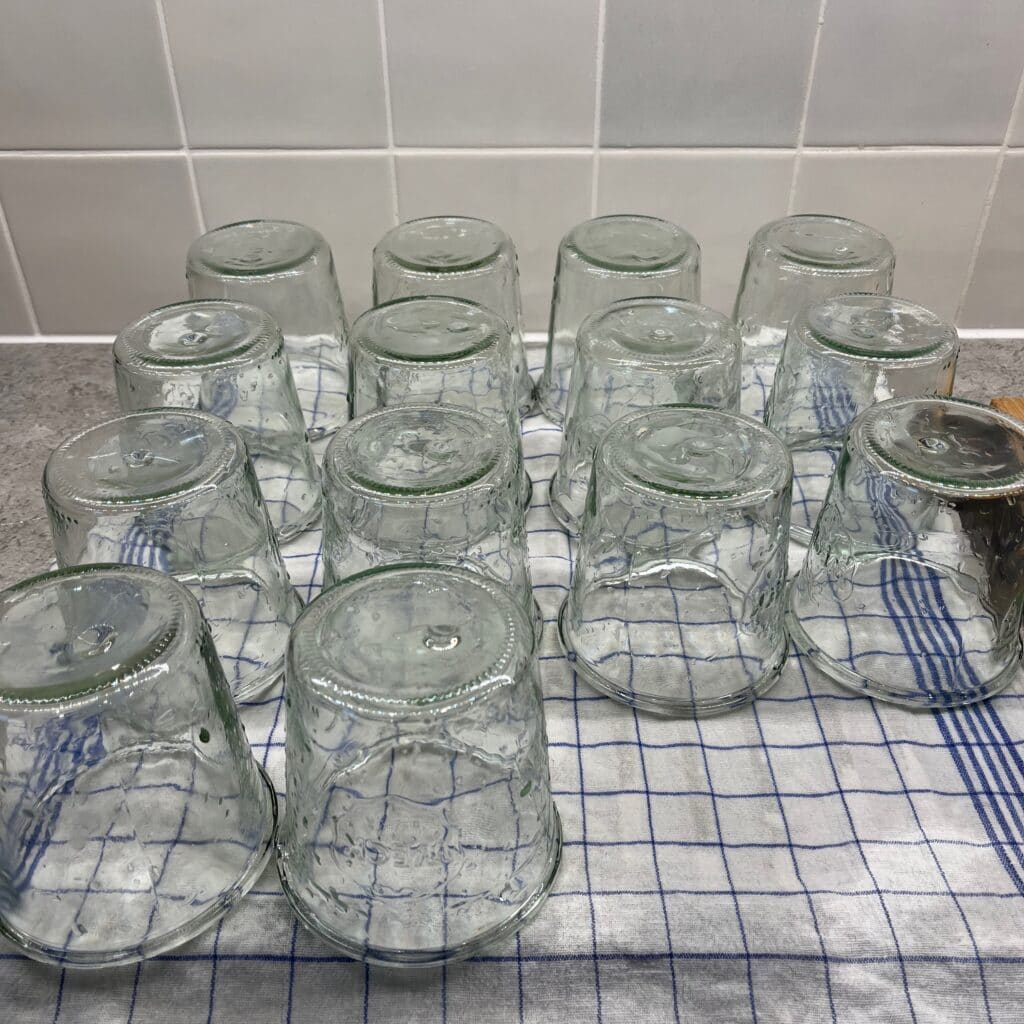
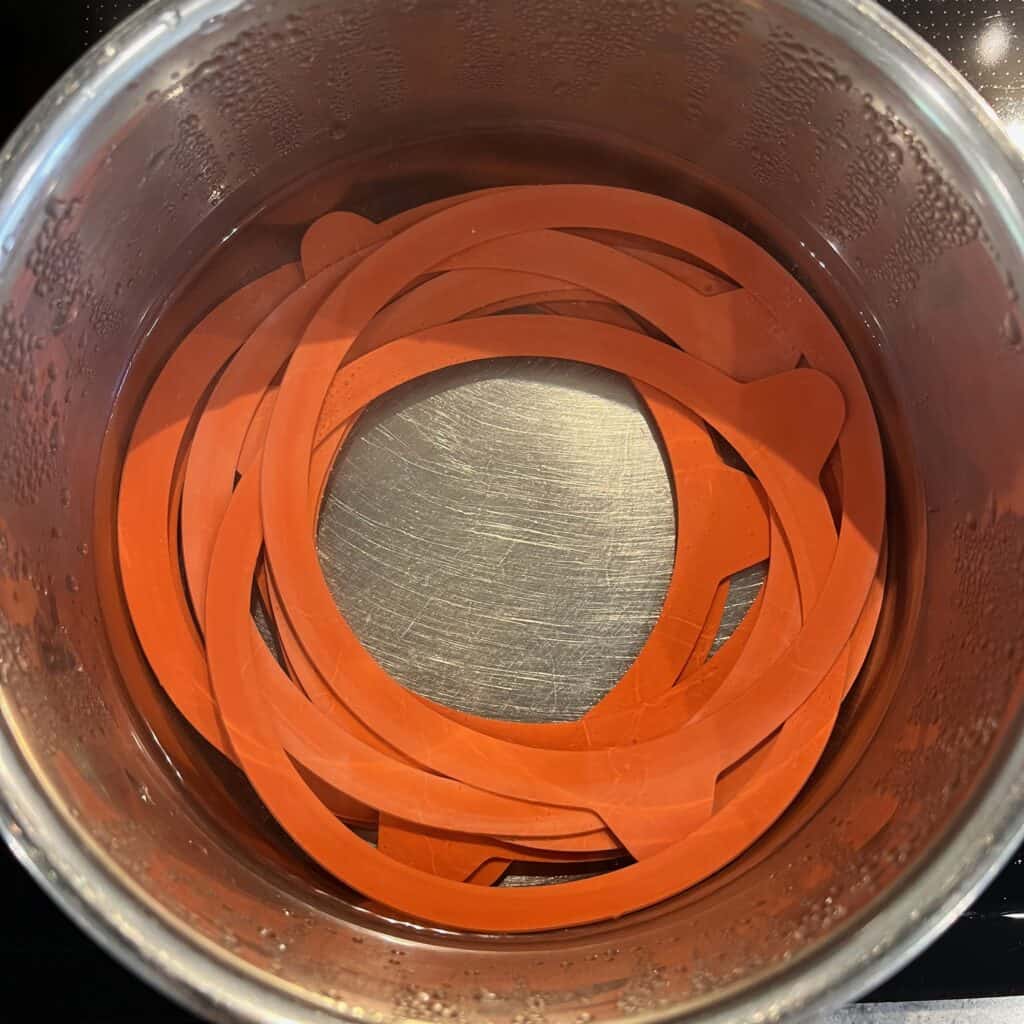
I let the jars and lids drain upside down on a clean dish towel on my dish drainer. I don’t towel dry them. I put the rubber rings in a small pot of boiling water with just a pinch of citric acid or vinegar to prevent limescale deposits. Once they’ve boiled for a bit, I put the lid on, turn off the heat, and let them sit until I’m ready to use them.
Filling Weck jars to the right headspace
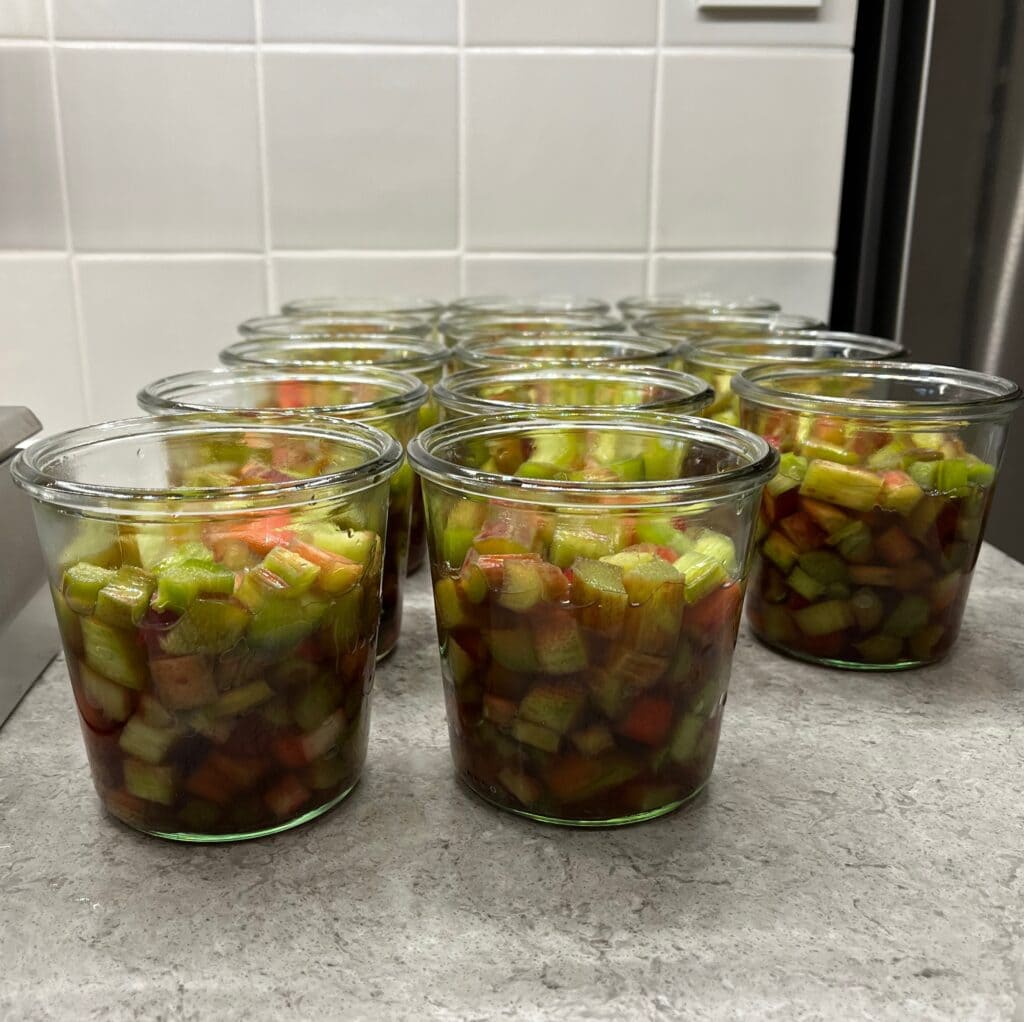
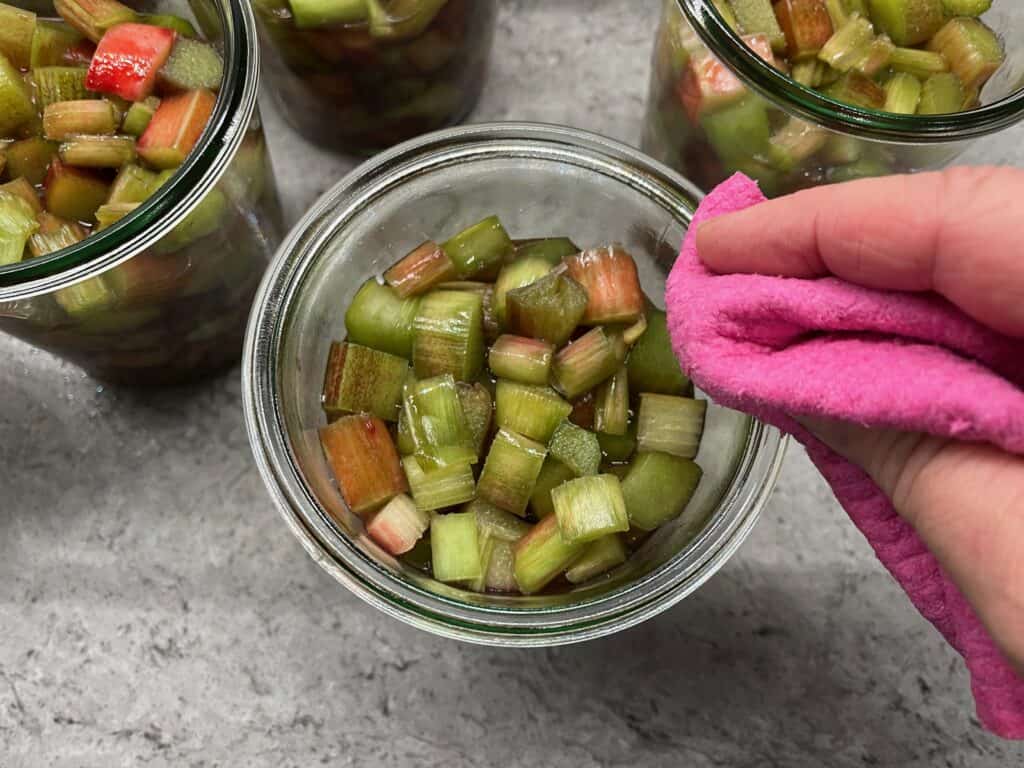
Next, I portion the food into the jars. I like to use a wide-mouth canning funnel to keep the rims clean and a kitchen scale to make filling easier. I place an empty jar on the scale, zero it, then fill to the correct headspace. Then I zero it again, and fill the remaining jars with the same amount. It’s faster than measuring each one and more accurate than eyeballing. Plus, if all jars contain the same amount of food, it’s easier to spot if something siphons during processing. Then I wipe the rims with a clean damp towel.
Check out my guide to essential canning equipment for water bath canning – Weck-compatible and beginner-friendly.
Hate half-full jars? Me, too!
Here’s a little trick I use that you fellow detail-watchers might like: Before I start filling jars, I take the total weight of whatever I’m canning and divide it by the known capacity of my go-to jars. That tells me roughly how many jars I’ll need, and then I adjust the amount per jar to avoid ending up with a “extra half jar” at the end. It’s not essential AT ALL, but satisfying if you’re the type who likes tidy rows, full jars, and no surprises.
Putting on the Weck rubber rings lid clamps
Next, I build the lid–ring assemblies and put them onto the jars. I make a stack of 5–6 lids (more is too wobbly) top side down on my counter and put the rubber rings from the hot water onto a clean towel next to the stack, drying them a bit. I seat a ring onto a lid and then place the assembly onto a jar of food, aligning it with my planned direction (see note below).
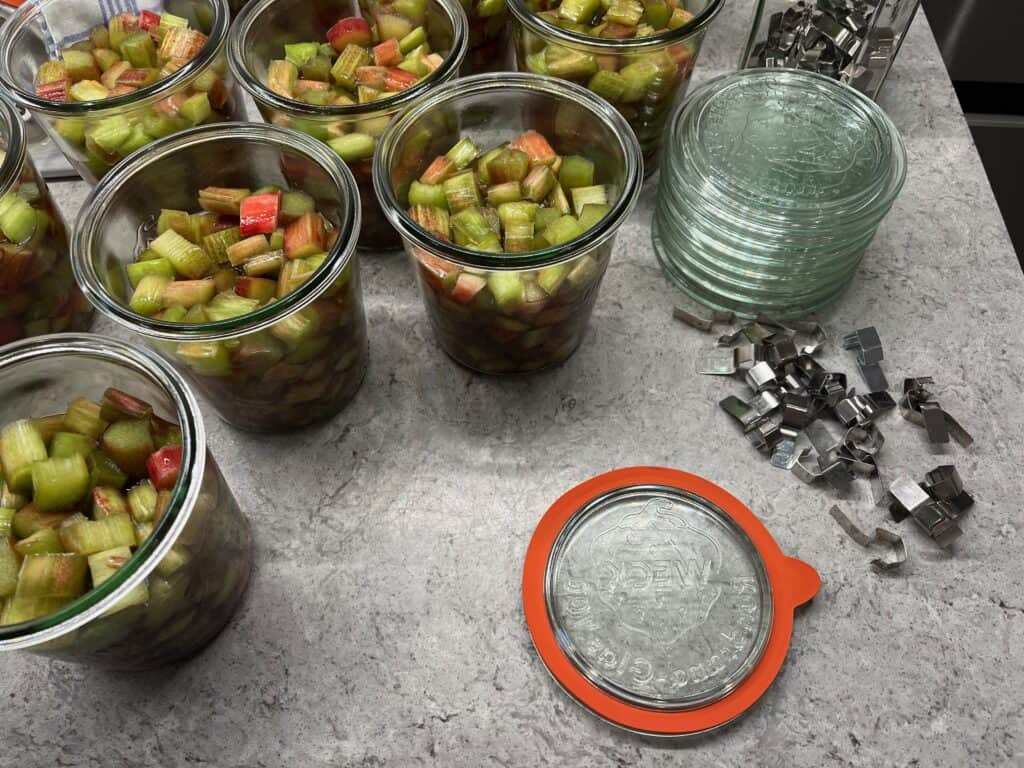
Use the rubber tab as a secret code
This tip is for the batch-splitters among us. When I’m canning a big batch with subtle variations – like sugar in some jars and honey in others – I use the rubber tab on my Weck jar gaskets as a visual marker. I always point the tab to the right when the strawberry on the jar faces forward. Then I use that orientation to code differences: tabs facing one way might mean “salted,” while the other is “plain.” It’s not necessary, but it helps me keep track of minor tweaks before the canning labels go on.
Seating the rubber ring correctly is important for a good seal. I use my fingers (clean hands!) to push the ring down evenly all the way around the lid. If the ring has been used before and it isn’t perfectly flat, I seat it in the opposite orientation that it was used in before. You can tell by the direction it’s deformed. And, if a ring is stretched out such that it doesn’t hang on to the lid when I flip it over, I toss the ring. It’s too stretched and might not seal properly.
Once the jars have lids, I add two clamps opposite each other. I find it’s easiest to clamp the top part first and then press the lower part down. This helps avoid chipping the glass rim, which can happen if you do it the other way around.
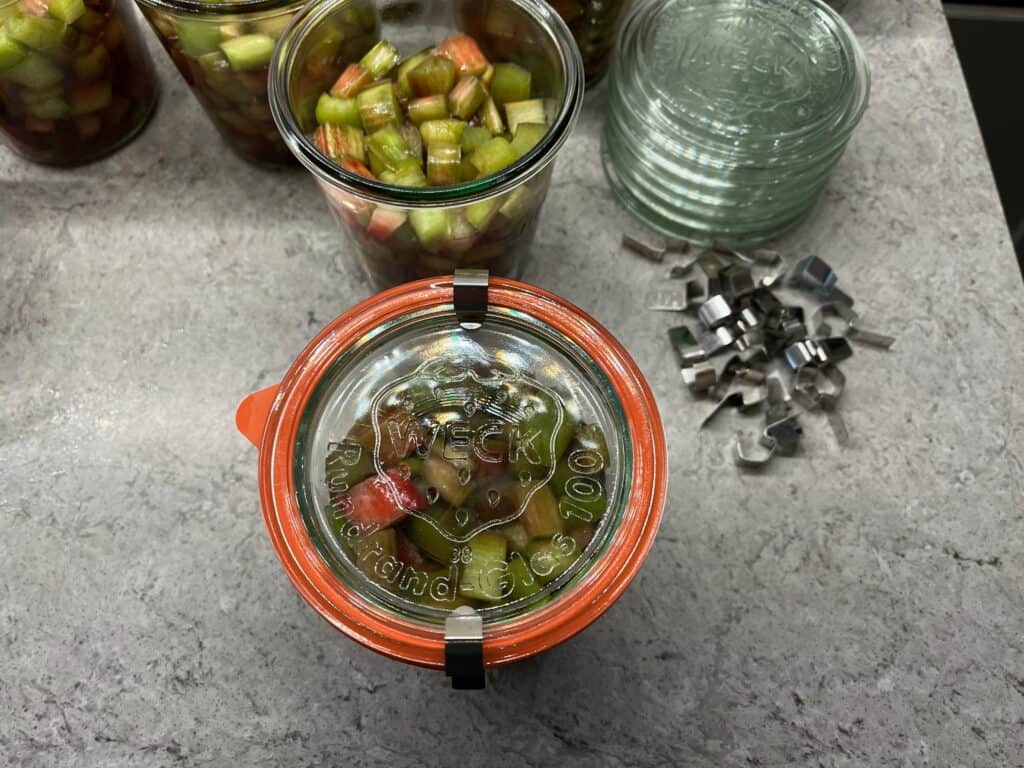
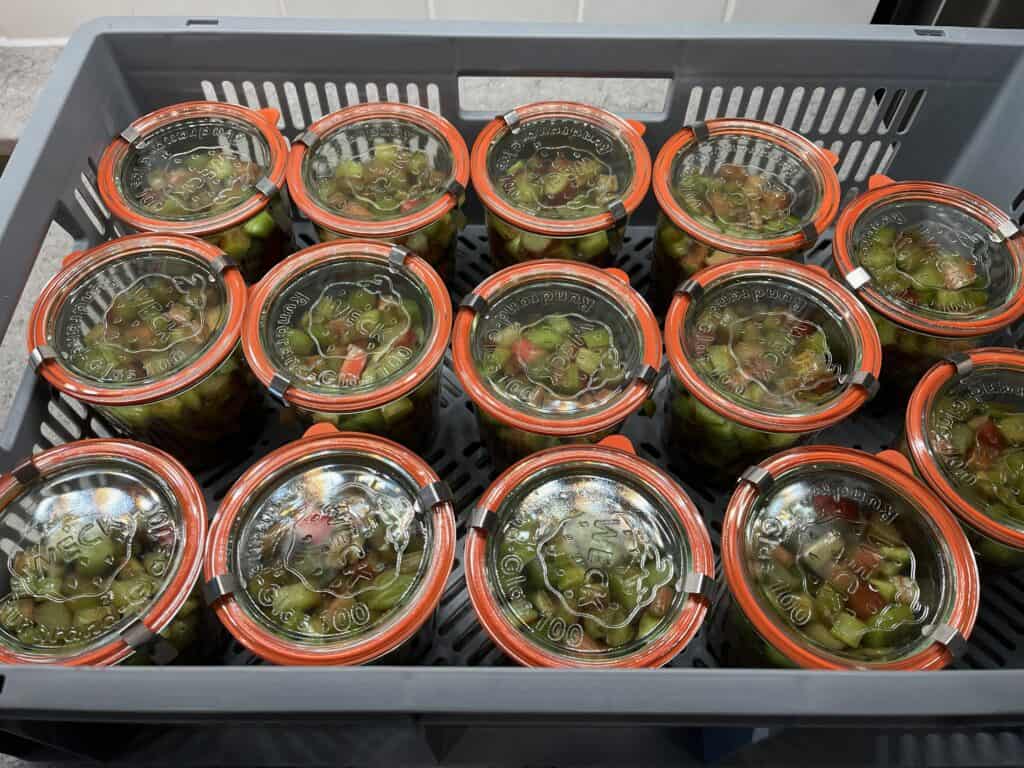
Then I inspect each jar, to make sure the clamps are positioned correctly and the rubber ring isn’t bulging. Sometimes, the rubber ring just doesn’t look quite right, like in the jar of black currants on the right side, so I’ll take the lid off, re-seat the ring, and then re-apply the clamps.
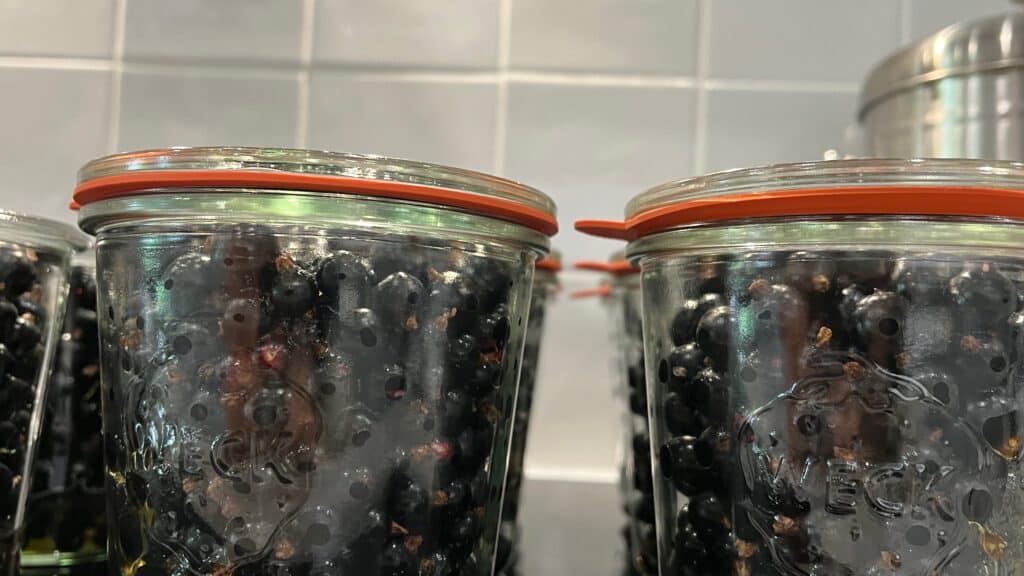
The clamps should sit vertically, exactly opposite each other like this:
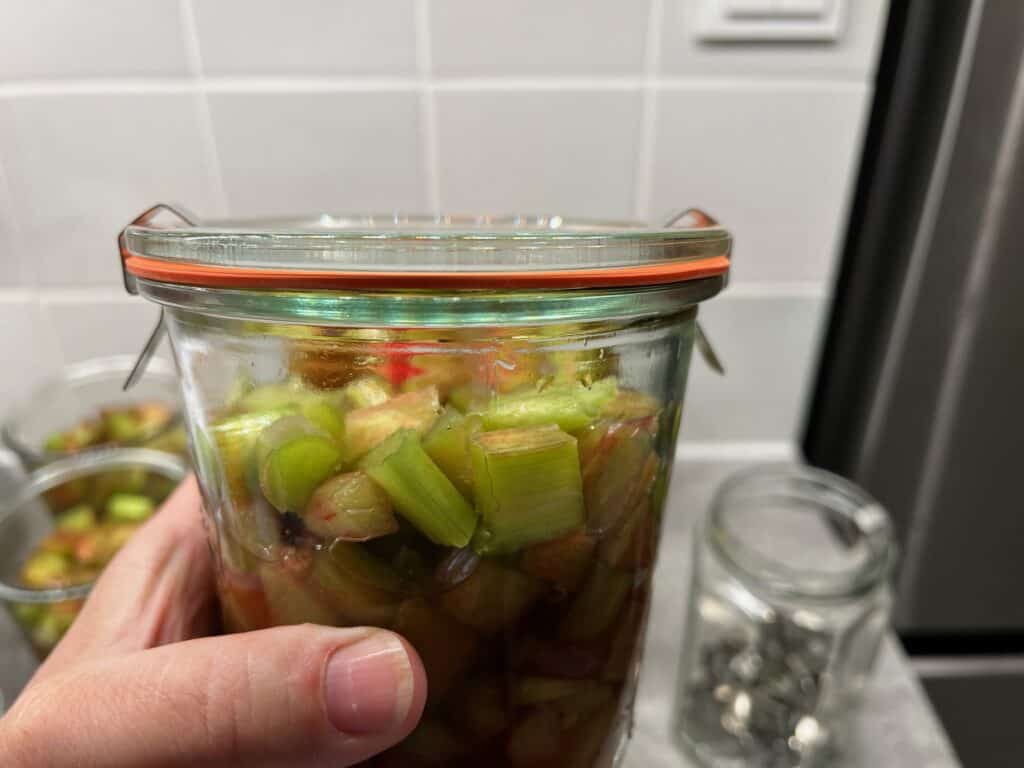
Then I put the jars into a Euro crate for transport to my canner (I almost always can outside).
Loading Weck jars into the canner
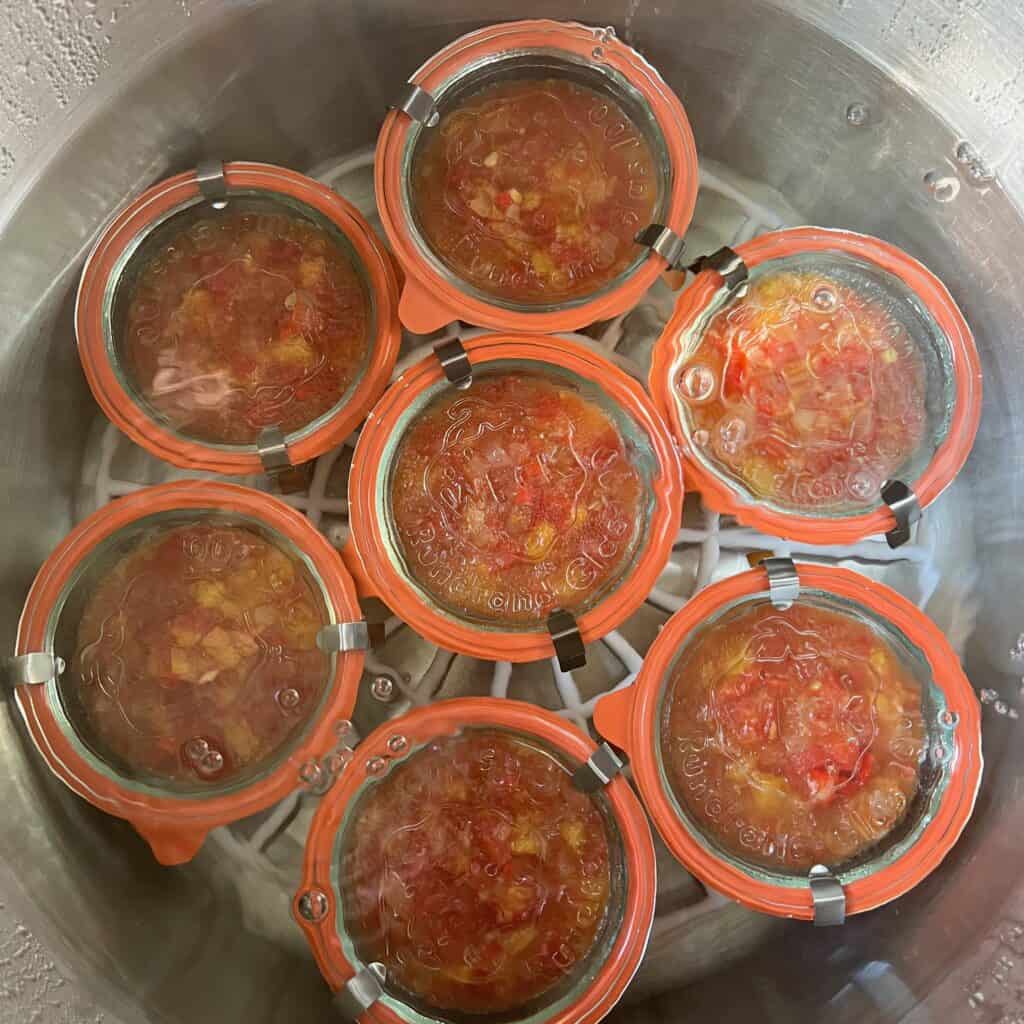
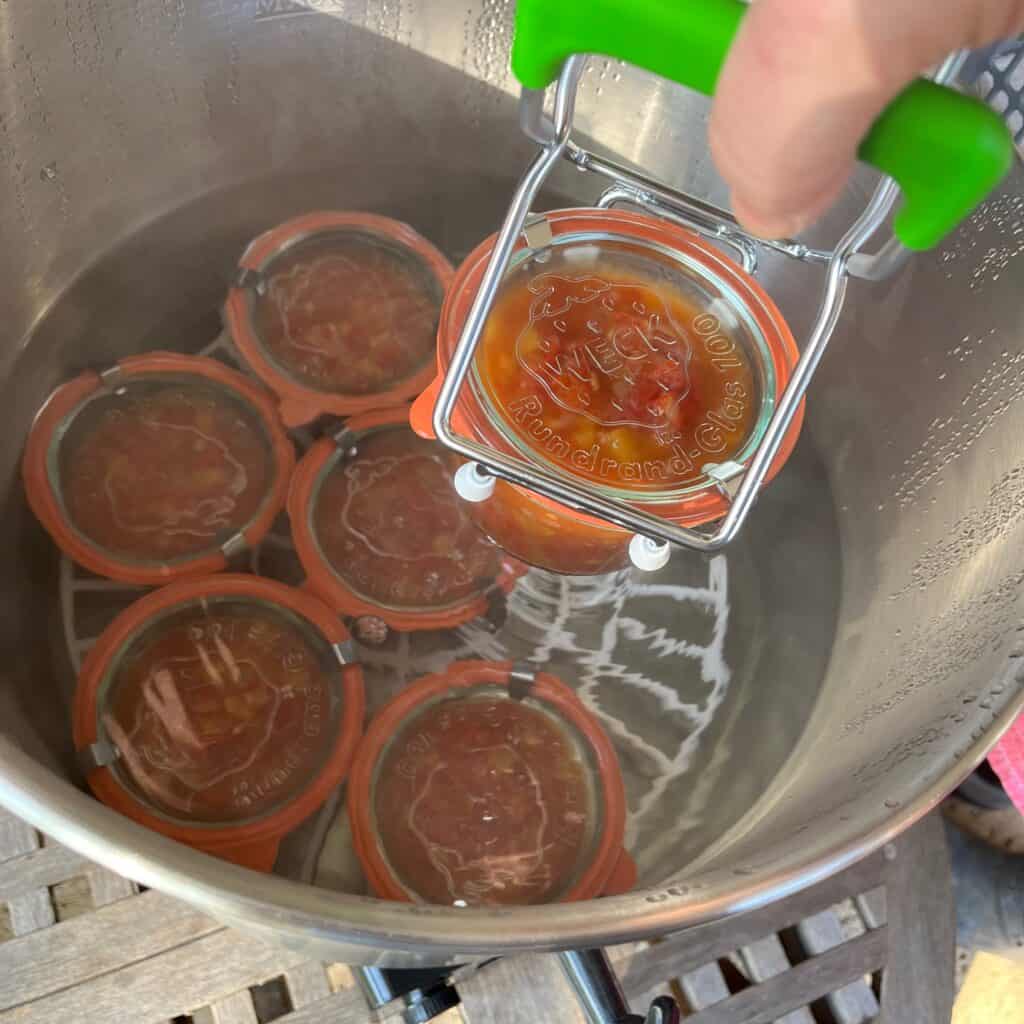
I place the jars in my canner, onto the rack that came with it. If the water temperature allows, I just use my hands, but if it’s already too hot, I use a Weck brand jar lifter with finger-like grips. It doesn’t feel secure to use my American-style curved jar lifter for the larger diameter jars.
Once the jars are in, I adjust the water level if needed (with pre-heated water if the canner water is already hot). I bring the canner up to boiling, start the timer, and let it run for the full processing time.
Avoid sudden temperature shocks (or, How I popped a clamp off a jar!)
If you’re using a water bath canner with Weck jars, don’t pour boiling water into a canner of jars that hasn’t yet reached boiling point. I learned this the hard way: I dumped a kettle of hot water into the pot too quickly, and the sudden temperature change forced a big whoosh of air out of one jar. It was so abrupt it actually popped one of the clamps off and let canning water into the jar of food. That kind of pressure release is exactly why Weck jars use two clips, but also why you shouldn’t use more than two. More clips can hold the lid down too tightly, making it harder for air to escape gently as it should.
Removing Weck jars from the canner without disrupting the seal
When the time’s up, I turn off the heat and let the jars rest in the water for five more minutes before removing them. It gives everything a chance to settle. I take the jars out very carefully, using the Weck jar lifter and pay close attention to avoid disturbing the lid.
Don’t disturb the lid when lifting jars out
When pulling hot Weck jars out of the canner, be very careful not to disturb the lids. My jar lifter has a little crossbar built into it, and if I grip the jar too low, that bar can press against the lid as I lift. I’ve had it happen a couple of times, just enough pressure to lift the lid slightly and release a tiny whoosh of air. In my experience, those jars don’t seal. If you notice that one jar isn’t still bubbling like the others after removal, that could be why. If it happens, use it as a learning experience, put them in the fridge, and use them within a few days. This is a downside of Weck jars.
I place the jars one layer deep in Euro crates lined with a towel and move them to a draft-free spot in the house to cool for 24 hours.
Checking to see if the Weck jars are sealed
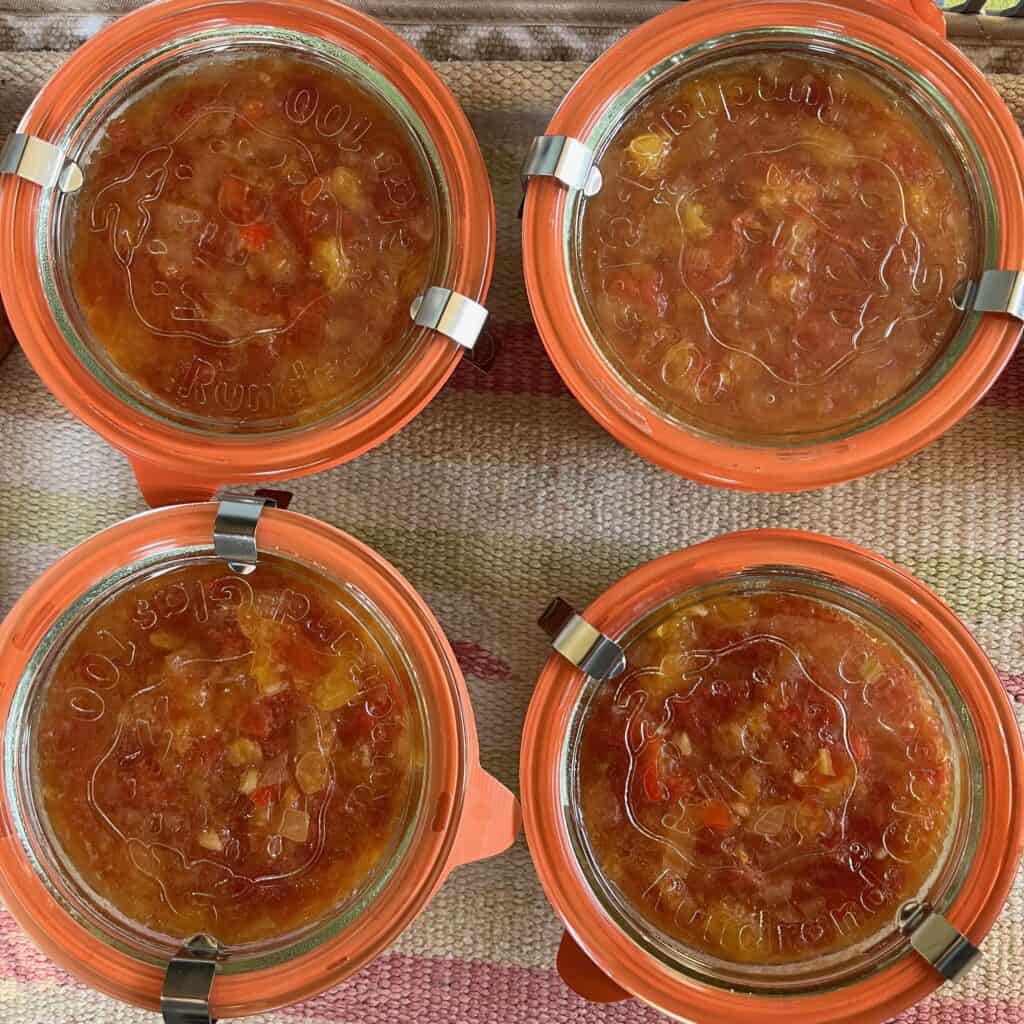
The next day, I check the seals. I remove the clamps and gently lift each jar by the lid. If it’s sealed, the vacuum holds. If the lid comes off, you can either reprocess immediately or store that jar in the fridge to use within a few days. Just to clarify, I’m holding the jar with the pads of my fingers, not digging in between the seal and the lid with my fingernails. If you do the latter, you’ll surely break the seal.
Storing and using Weck jars of home-canned food
I label the sealed jars and put them on the pantry shelf, stacking if needed. I store the jars with the rubber tabs pointing in the same direction. Most of the time, the rubber tab points a bit downward when the jar is sealed. This isn’t a hard rule, but I’ve never experienced otherwise. When I’m in my pantry, I glance to make sure all the tabs are still pointing down and make sure nothing smells off. So far, I haven’t experienced any seal failures. When it’s time to open a jar, I just pull the rubber tab to break the vacuum and lift the lid. Simple.
Advantages of canning with Weck jars
One of the first things I appreciate about canning with Weck jars is that I can see what’s going on inside – even the top of the food. The glass shows the food from all sides, and I can also see the seal. Sometimes the rubber gasket shifts just slightly during processing. Maybe it bulges or looks uneven. When that happens, I don’t need to guess. I just put that jar in the “use soon” box or leave it on my kitchen counter. It’s a small visual cue, but a really useful one.
The jars and glass lids are high quality and definitely reusable. The rubber rings can be reused too, as long as they’re not stretched out, not dried out, and don’t smell strongly of food. I reuse mine multiple times without trouble. And so far, I’ve had excellent luck with sealing. The few that haven’t were almost always because I bumped a lid or jar while removing it from the canner and broke the seal before it had fully formed.
They also stack beautifully. The recessed lids make it easy to stack jars without fear of wobble or tipping. When empty, they nest neatly, so it’s easy to store my jars in a small footprint.
They’re also robust enough for commercial use. Here in Germany, supermarkets and farm shops often sell specialty foods in Weck jars. You pay a deposit when you buy them (which you can get back by returning the jars), so it’s a practical loop. That kind of repeated use wouldn’t work if the jars were flimsy or prone to breakage.
I was lucky and found a nearby farm store that will sell these jars for the deposit price of one euro – a pretty good bargain. Now, I have hundreds. And if you’re a canner, you know how great that is.
This post focuses on the Weck jars. For my full procedure for German-style water bath canning, check out this post.
FAQs about canning food in Weck jars
Yes, Weck jars are safe for home canning. They were originally developed in Germany in 1895 by Rudolf Rempel, and they’ve been used safely for over a century. Both the vintage-style and modern Weck jars are the standard canning jars in Germany and, when used properly, they create a reliable, visible vacuum seal.
Yes, that’s exactly what Weck jars are designed for. Water bath canning is the traditional method Germans use for preserving both high- and low-acid foods using extended times in boiling water. Weck jars are made to handle this method safely and effectively.
Yes, Weck jars are heat safe and built for repeated boiling-water canning. They’re commonly used in both home kitchens and commercial specialty food production in Germany. Like any glass, they should be heated gradually to avoid thermal shock and breakage.
After 24 hours, remove the metal clamps and gently lift the lid by its edge. A properly sealed jar will hold the lid firmly in place due to the vacuum inside. If the lid lifts off easily, the jar did not seal and should be refrigerated and consumed within a short time or reprocessed immediately.
Weck rubber rings can be reused multiple times if they’re still flexible, not stretched out, dried out, or strongly scented from previous use. If a ring won’t stay on the lid when flipped upside down, it’s likely too stretched and loose to ensure a safe seal and should be discarded.
Once the jars are sealed and cooled, and you have removed the metal clamps and confirmed the seals, you should label them as you like and store them in a cool, dry place out of direct light. Store jars without the clamps so you can easily spot any seal failures. The recessed glass lids make the jars easy to stack safely on pantry shelves.
Keep reading
More from Canning
Free 7-lesson course + newsletter
Canning Science Foundations
Seven short lessons on the biology behind home canning: why the rules exist, what actually keeps food safe, and how to look at any recipe and see where the safety lives (no chemistry degree required). Finish them and you stay on for the newsletter: seasonal harvests, kitchen experiments, and the science behind each one.

Julie Kaiser is a molecular biologist and science writer who has lived in Germany since 2011. She spent over a decade in virology and national security research labs before becoming a professional science writer. She came to German water bath canning the way scientists come to most things: by reading the primary sources and deciding the evidence held up. Old World Preserves is where she writes about what she’s learned and what she’s growing, cooking, and preserving in her Lower Rhine garden.