
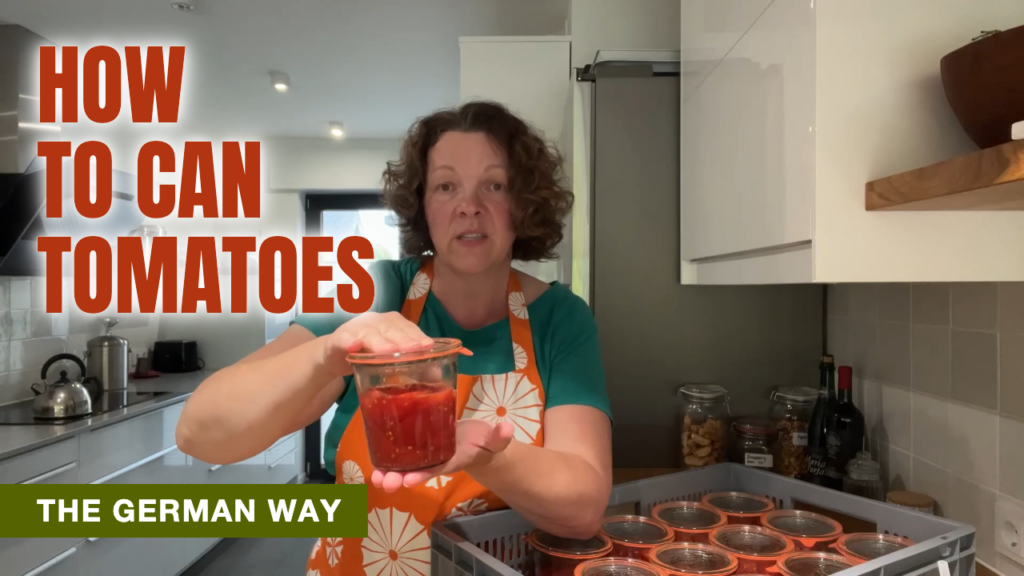
Canning tomatoes the European way (skins on, no pressure canner)
Today I’m canning tomatoes. No peeling, no lemon juice, and no pressure canner. If you learned canning in the US, you probably think that sounds wrong. But here in Germany, where I live, this is a normal way to can tomatoes, in a home canning tradition that goes back over 100 years (1).
I’m Julie Kaiser. I live on the Lower Rhine, and I can food at home according to the German tradition. I grew up in the US, though, and learned a very different set of canning rules, which contradict what they do here.
In the video, I can 14 jars of tomatoes from my garden, start to finish, in a water bath canner. I also answer the questions I keep seeing people ask on online canning forums about canning tomatoes. And one of those 14 jars doesn’t make it. I’ll show you what happened and what I did about it.
If European canning is new to you, my free video course, Canning Science Foundations, explains the fundamentals. It’s a playlist you can watch whenever you like, with no signup.
- Tomatoes: ripe but not overripe, no bad spots, washed, cored, skins on, cut into pieces
- Pack: raw, in their own juice. No peeling, no blanching.
- In the jars: tomatoes and a little salt (optional). No lemon juice, no citric acid.
- Amount: about 4.6 kg (a little over 10 pounds) of prepared tomatoes for 14 WECK jars of 580 ml (about 20 fluid ounces), about 330 g (11½ ounces) per jar
- Headspace: about 3 cm (1¼ inches)
- Processing: water bath, 30 minutes at 90°C (194°F), timed from when the water reaches that temperature
- Result: 13 sealed jars for the pantry, 1 jar into the fridge
- Before eating: throw out any jar that has come open in storage or looks or smells off.
- Plain tomatoes only. With onions, garlic, meat or other vegetables in the jar, the time can change: see canning tomatoes with other ingredients.
How to can tomatoes the German way, step by step
To can tomatoes the German way, you wash, core and cut ripe tomatoes with the skins on, salt them if you like, pack them into clean jars, close the jars, and process them in a water bath for 30 minutes at 90°C (194°F). I’ve added timestamps to the video, so you can jump to any part you want. (More on German water bath canning for foods beyond tomatoes.)
1. Wash the jars and lids
Soapy water, rinse well, drain. Whenever you’re canning, always start with clean jars. Mine live in a musty basement, so I wash them with soapy water, rinse them well, and let them drain at the start of my canning. Same with the lids: wash, rinse, and let them drain so everything’s ready when I need it.
I use WECK jars because those are the commonly available jars here in Germany. Prepare your jars according to whatever type you’re using. (More on canning in WECK jars.)
2. Prepare the rubber gaskets (WECK jars)
Bring the gaskets to a boil in water with a little citric acid or vinegar, then leave them in the hot water. I put my rubber gaskets into a pot of water with a little citric acid. You can also use vinegar. I bring it to a boil, turn it off, and leave it on the stove until I’m ready to use them. I add the acid because our water here is really chalky, and the acid keeps chalky residue off the gaskets.
3. Sort and wash the tomatoes
Pick out any tomatoes with bad spots, then wash and drain the rest. The tomatoes I’m canning are a mix of Roma, San Marzano, De Berao, and I think a few others. I’ve already picked through them to make sure none of them have bad spots. Then I clean them in tap water and put them in a drainer to drip dry.
4. Core the tomatoes (no peeling, no blanching)
Take out the cores. Leave the skins on. I remove the cores before canning, because I really don’t like the texture if I leave them in. I use an apple corer to take out a little plug of the core from each one.
I’m not peeling these tomatoes, and I’m not blanching them. I’m cutting them and canning them directly in their own juice. This is different from the USDA-recommended way of canning, and I’ll explain why in the questions below.
5. Cut and salt the tomatoes
Cut into quarters, sixths or eighths. Stir in about 2 tablespoons of salt per 2 kg (4.4 pounds), if you like. I cut my tomatoes into pieces according to how big they are: usually quarters, or sixths or eighths if they’re particularly large. They all go into my big stainless steel bowl.
I like to add salt when I’m canning tomatoes, usually a couple of tablespoons for 2 kilos. It’s not necessary for safety, and you don’t have to add it. It starts pulling the juice out of the tomatoes, so when I put them into the jars, it’s easier to get rid of the air pockets. I split the tomatoes between two bowls so there’s room to stir in the salt, and give both one more good stir before filling the jars.
This year I’m not adding any lemon juice or citric acid to my tomatoes. I’m canning them the way people have been canning plain tomatoes here in Germany for a long time. (I explain why in the questions below.)
6. Weigh and fill the jars
About 330 g (11½ ounces) per 580 ml jar, leaving about 3 cm (1¼ inches) of headspace. I always weigh what I’m canning, so I know how much goes into each jar and how many jars I’ll get, instead of letting it be a surprise at the end. Here I have about 4.6 kilos of prepared tomatoes (a little over 10 pounds) for 14 of the 580 ml WECK jars. I know from past canning that about 330 grams per jar gives me about 3 cm (1¼ inches) of headspace, comfortably.
I could probably fit in a little more and still not get any siphoning, but this works. I cook with two of these jars at a time anyway, so a little more per jar wouldn’t get me much.
You can eyeball the amount, too. Make sure you leave the right headspace for your processing time. Then go back through and top off any jars that look like they could use a few more tomato pieces. There’s no added liquid: these are canned only in their own juice. The headspace is measured from the top of the food and liquid to the top of the jar.
A note on headspace. Headspace is specific to the method and processing time you’re using, not the kind of jar. American recipes often use smaller headspaces with their processing times (2), and here we often use bigger ones. Both work. Too little headspace for your process, and the contents can bubble out and spoil the seal. Too much, and the process may not drive enough air out for a strong vacuum. So use the headspace that goes with the processing method you’re following.
7. Press out the air and wipe the rims
Press the tomatoes down with a clean jar, then wipe the rims. I press the tomatoes down with a clean jar to push out the air. Since I have liquid from salting them earlier, it fills in those air spaces nicely, and everything packs down well. Then I wipe the rims clean with a clean, damp cloth.
8. Close the jars
WECK jars. I take the rubber gaskets out of the hot water and put them onto a towel where I’m working. There’s no need to dry them. I put a gasket onto a lid and turn the lid upside down. As long as the gasket stays put, and it’s still stretchy and hasn’t dried out, it’s okay to use again. If a gasket is stretched out and won’t stay on the lid, I throw it away. It could still work, but I don’t want to take the risk, so I take a new one.
Once all the lids are on, I put on the metal clips. Make sure the lids are seated properly and the gaskets aren’t bulging out or buckling anywhere, all the way around the jar. On a properly clamped jar, the clips sit straight up and down, not off at an angle.
Mason-style jars with a two-piece lid. The band goes on finger tight, so air can escape during processing. You don’t want to do the wrist action. It’s really only finger tight.
Twist-off lids. These get closed all the way, nice and tight. (More on reusing jars like these from the supermarket in the questions below.)
9. Load the canner
Water at about the same temperature as the jars, covering them or at least three quarters of the way up. Once every jar is clamped shut, all 14 go into my canner. I like to can outside on the terrace, so it doesn’t heat up my kitchen on hot summer days.
The temperature of the water should always roughly match the temperature of the food you’re putting into the canner. My tomatoes are at room temperature, so I use room-temperature water. If I were putting in something that was already hot, I’d use hot water.
In German water bath canning, you either cover the jars with water or fill the canner at least three quarters of the way up the jars (3). Mine are under water.
Then I sprinkle a little citric acid into the canning water, because our water here is mineral heavy, and the acid helps keep a chalky film off the outside of the jars during processing. It has nothing to do with the tomatoes themselves. You can also use vinegar or leave it out entirely, but you might get a white film on the outside of your jars.
10. Process for 30 minutes at 90°C (194°F)
Start the 30 minutes when the water reaches 90°C (194°F), and keep it at or above that the whole time. The lid goes on, and I set the timer for 30 minutes at 90°C (194°F). This is the common water bath time and temperature for tomatoes here in Germany (4). In my canner, once the water reaches that temperature, the machine beeps a few times and the timer starts counting down. It keeps counting as long as the water stays at or above it.
You don’t have to have a canning machine like mine. Any big pot with a lid works, if it holds enough water and you can hold the processing temperature. But you do need a thermometer to make sure you reach and keep that target temperature. The water has to stay at or above 90°C (194°F) for the full processing time.
Here in Germany, we typically use the same processing time for all jar sizes. I have seen some sources recommend longer times for jars of 1 liter and up. Hildegard Rust’s book, for example, gives 40 minutes instead of 30 for jars of 1 to 1½ liters (5).
11. Let the jars rest, then lift them out gently
Heat off, lid on, jars stay in the water about 5 minutes. Then lift them out without bumping the lids. I turn the heat off, leave the lid on, and let my jars sit in the canning water for about 5 minutes before I take them out, to let the pressure inside the jars stabilize a bit. People do this differently: some take their jars out right away, and some leave them in for a few minutes. In my experience, when things have been boiling, they can start boiling pretty aggressively when you take them out. That’s not the case with tomatoes, but it’s why I always leave my jars in for five minutes, no matter what’s in them.
Then I carefully take them out with a jar lifter. I like to put mine into Euro crates with a towel on the bottom, so there’s something to soak up the liquid in case anything breaks.
Be sure not to disturb the lids or clamps when you’re taking the jars out of the canner. I have to say, that’s one of the disadvantages of WECK jars: if you accidentally bump a lid while taking the jar out, you can break the seal that’s already starting to form, and then it won’t be shelf stable.
12. Let the jars cool, then check the seals the next day
Let the jars cool, move them only gently, and leave them overnight. Then take off the clips or bands and test each lid. The temperature outside is mild, not too hot and not too cold, so I leave the jars out on the terrace for a few hours until they cool. Then I bring them inside carefully, without disturbing them.
Once the jars have sat overnight and cooled completely, it’s time to take off the clamps and check the seals.
- WECK jars: take off the clamps and lift the jar by the glass lid. If the lid holds, the vacuum holds, and the jar is sealed and ready for the shelf.
- Mason-style jars: twist the band off completely and remove it. Then do the same: pick the jar up by the metal lid. If it holds, the jar is sealed.
- Twist-off lids: if there’s a button in the lid, it should be pushed down and not click. If there’s no button, look at the center of the lid. If it’s pulled down and slightly concave, it’s sealed.
13. What if a jar didn’t seal?
If your jar didn’t seal, you have two choices. If it’s been less than 24 hours, you can process it again with a new lid or gasket. Or you can put it in the refrigerator, use it within a few days.
The jar that didn’t make it
This one was a different kind of failure: the jar came open during processing, and canning water got in.
I had a peek before taking the jars out, and I knew one of them had failed. The clip had come undone, so the jar opened up a little on one side, and my canning water went inside.
I don’t really know why it happened, because I did check that the clips were positioned correctly. Once the jar cooled, I lined that clip up next to another one, and it looked like it had less tension. I threw that clip away.
This happens every now and then, and I wasn’t worried about these tomatoes. My canner doubles as a hot drink dispenser, so it’s clean. The canning water came straight out of the tap and was clean when I put it in, and those tomatoes went through the same process as the others.
So I dumped out the water and put the tomatoes in the fridge, and later that week they went into a pasta dish. But I wouldn’t do that if the canner wasn’t clean enough that I’d be comfortable drinking the water from it.
German vs USDA water bath canning for tomatoes: same tomatoes, two systems
Here’s where the two systems differ (2, 4, 5, 6, 7).
| What differs | German water bath (how I can them) | USDA water bath |
|---|---|---|
| Tomatoes | washed, cored, skins on | peeled |
| Acid in the jar | none added | bottled lemon juice or citric acid in every jar |
| Time and temperature | 30 minutes at 90 to 100°C (194 to 212°F) | at a boil, 100°C (212°F), for the time in the tested recipe |
| Headspace | about 3 cm (1¼ inches) in my jars | ½ inch (about 1.3 cm) in the tested recipes |
| Jars | WECK jars, Mason-style jars, reused twist-off jars | canning jars with new lids |
| Where the rules come from | about 125 years of tradition, going back to when WECK taught people to can with its jars | recipes the USDA has tested |
Who’s right? No one, really. It’s a different tradition here, and a different approach to food safety. (More in Is USDA canning the only safe way?)
Questions people ask about canning tomatoes
Can you can tomatoes with the skin on?
In German home canning, yes: tomatoes are routinely canned with the skin on, and peeling comes down to your own preference. You can watch me do it in the video.
In the American canning system, every recommended canning recipe is one that’s been officially tested. When it comes to tomatoes, the lab tested peeled tomatoes, so most of the recipes say to peel your tomatoes (7). As far as I can find, they never tested canning tomatoes with the skins on. And in that system, if they didn’t test it, they don’t recommend it. But that’s not the same as saying someone tested it and found out it’s not safe. I haven’t found any study that tested skin-on tomatoes and found a problem. The reasons usually given for peeling are that skins might slow heat getting into the tomatoes, and that they can carry more microbes. I wash mine well and cut them into pieces.
We don’t have officially tested canning recipes in Germany. What we have is 125 years of canning tradition (1), which started when the WECK company was selling a canning system and teaching people how to can food with it. That’s why peeling tomatoes for canning is optional here, and German canning books have tomato recipes both ways (4, 6). If you don’t like tomato peels, you peel your tomatoes. If you don’t care, you wash your tomatoes, make sure you’re not putting in any spoiled parts, and let the processing do its job.
There’s no rule in German canning that says you have to peel anything. The informal rule is that you peel what grows underground: if a vegetable’s skin was growing under the ground, in the soil, you peel it, because soil is where the spores live (8). Tomatoes grow above ground, so mine get a good wash instead.
I leave the skins on my tomatoes because they don’t bother me, and to me it’s not worth the extra effort to remove them.
Do you really need lemon juice when canning tomatoes?
Not in the German canning tradition: here, plain tomatoes go into the jar with no lemon juice or citric acid.
If you learned canning from American sources, you probably learned that every jar of tomatoes gets either bottled lemon juice or citric acid, with no exceptions. If you learned canning here in Germany, you have probably never heard of that, unless you ran into it on an American canning forum.
As a molecular biologist who spent a decade in virology and national security research labs before becoming a science writer, I picked apart the science behind the German method. Tomatoes sit right around the acidity line that separates high-acid canning from low-acid canning, and some tomatoes have been measured above pH 4.6. The ones in my pH guide range from 3.99 to 4.75, and the same study measured local vine-ripened tomatoes up to 4.98 (9). That’s where the line is. Above pH 4.6, Clostridium botulinum bacteria can grow and produce the toxin that causes botulism (2). (More on botulism and home canning.)
Here’s the short version of how the US got its tomato canning rules. Tomatoes used to be considered acidic enough on their own, and they were often filled hot into jars with no processing at all (10). Then some botulism cases were traced to home-canned tomatoes (11), and researchers started digging. Most of those records don’t say how the jars were canned, and the ones I’ve found that do describe tomatoes that were barely heated in the jar or not processed at all.
Researchers found that some tomatoes measure above pH 4.6, especially overripe ones (12). In a lab study where they put mold and botulinum spores into tomato juice on purpose, in containers that weren’t airtight, the mold raised the pH around it, and the spores grew and made toxin there (13). And when they tested 31 jars of tomatoes that home canners sent in, all but two were below pH 4.6; those two had no acid added, and the researchers still judged all 31 acidic enough to stop botulinum growth (12). The USDA’s answer is that tomatoes sit too close to the line: everybody has to add lemon juice or citric acid to their tomatoes, so they’re always on the safe side of that pH 4.6 border (2). Germany and WECK didn’t adopt that rule.
Here, we start with clean, ripe tomatoes, not overripe ones, since tomatoes get less acidic as they go past ripe (12). We treat them as a high-acid food, and we process them accordingly. And if a jar comes unsealed in storage, or you open it and it smells funny or looks funny, we throw it out. We don’t eat it.
Does the water have to be boiling for water bath canning?
Not in German water bath canning: here, the water for tomatoes doesn’t have to boil.
In American water bath canning, tomatoes are processed at a boil, 100°C (212°F). But that’s not how we do it here in Germany. The common time and temperature for plain tomatoes here is 30 minutes at 90°C (194°F) (4, 5). That’s what I use.
At 90°C (194°F), there’s enough heat to destroy most molds, yeasts, and other everyday spoilage organisms. And for high-acid food, that’s all that’s needed. In foods that are reliably below pH 4.6, Clostridium botulinum spores can’t germinate and grow, as long as nothing else grows in the jar and raises the pH (2, 11). Tomatoes sit right at that line, and the two systems handle them differently (the lemon juice question above). (More on this in what German water bath canning is.)
You can always use a higher temperature or a longer time, and some people here process at 100°C (212°F). That’s fine too. I like to stay at 90°C (194°F) for acidic foods that I can raw and with very little liquid, because these tend to move upward in the jar as they heat up during processing. When you process them at boiling temperature, I find the contents are more likely to reach the top, bubble, and siphon out through the seal. At the lower temperature, I can avoid that.
Can you reuse store-bought jars for canning?
Here in Germany, reusing store-bought jars and their lids for water bath canning is completely normal.
The store-bought jar I hold up in the video is a mushroom jar. The glass is perfectly fine, and as long as the lid is clean, not damaged, and the seal inside isn’t cracked or damaged, you can reuse these jars and lids for water bath canning. People here do it all the time. You can even buy replacement twist-off lids, because the sizes are standardized.
If you’re in the US and you follow those canning guidelines, you need to know that the USDA does not recommend reusing commercial jars that can’t take a two-piece canning lid, like that mushroom jar, or reusing lids (2). That system is built around dedicated canning jars with new lids. This is another one of the places where the two systems differ.
I should point out, though, that pressure canners aren’t common here. We can get them, but they’re not the trusted brands Americans have been using forever, and we have no way to maintain them, so people don’t commonly use them. So when I say we reuse these jars, it’s always in a water bath, at atmospheric pressure. They may not hold up to pressure canning. That’s a different story. (More on water bath vs. pressure canning.)
Canning tomatoes with other ingredients
When you ask a German canner how long to process tomatoes, there’s no one right answer. It depends on what the food is and who you’re asking. Here’s what they do, and what I do.
- Plain tomatoes and plain tomato sauce (tomatoes and salt, nothing else). Some people here still hot-fill, or open kettle, plain tomatoes: they boil them, put them in a sterilized jar, and put on the lid, with no processing at all. Others process them for 30 minutes at 90 or 100°C (194 or 212°F). I always process my plain tomatoes. I don’t make plain tomato sauce, but if I did, I’d still process it.
- Acidified tomato foods, like salsa. These have tomatoes, onions, peppers, and garlic, but they also have vinegar, in a set amount from a recipe that’s been worked out, enough to keep the whole jar on the safe side of the pH border. That means a short processing time is appropriate: 30 minutes at 90 or 100°C (194 or 212°F). (My chipotle tomato red pepper salsa is one.)
- Tomatoes with onions, garlic, and herbs, no added acid. Some experienced canners process these for 30 minutes at 100°C (212°F). Others say you added onions and garlic, so you need to process for two hours. I take the more conservative approach: 2 hours at 100°C (212°F). I don’t want to rely on guessing how acidic the mix is, so I use the time German canners commonly give for low-acid foods.
- Tomatoes with meat or other vegetables. Most people say 2 hours at 100°C (212°F), and that’s what I do. (My roasted red pepper and tomato soup and my tomato meat sauce both get 2 hours.) I heat my tomato meat sauce to a boil before eating it.
I always choose the cautious end of the range. That’s how I am. I’ve spent so much time growing the things in my garden, and I don’t want them to spoil.
Methods like open kettle canning carry more risk. We know this from the literature. If you choose a less cautious approach, there are things you can do to lower your risk. If a jar comes unsealed in storage, throw it out. If you see anything growing in a jar when you open it, throw it out. And if you want to remove that last bit of doubt about whether your food is safe to eat, boil it for 10 minutes, stirring so it’s bubbling all the way through (a minute longer for every 1,000 feet, or 300 m, of altitude). That inactivates botulinum toxin (14, 15). (Does boiling kill botulism spores?)
Sources
- Spiekermann, Uwe. 1997. “Zeitensprünge: Lebensmittelkonservierung zwischen Industrie und Haushalt 1880–1940.” In Ernährungskultur im Wandel der Zeiten, 31–43. Köln: KATALYSE and BUNTSTIFT.
- U.S. Department of Agriculture. 2015. Complete Guide to Home Canning, Guide 1: Principles of Home Canning. Agriculture Information Bulletin No. 539.
- WECK. “Einkochen Guide.” weck.de.
- J. Weck GmbH u. Co. KG. 2019. WECK-Einkochbuch: Anleitung zum richtigen und sicheren Einkochen. 33rd revised edition. Wehr-Öflingen. ISBN 978-3-921034-05-7.
- Rust, Hildegard. 2011. Vorrat halten: Einkaufen, Kühlen, Gefrieren, Einmachen, Lagern, Trocknen und Dörren, Einsalzen, Räuchern, Alkoholische Gärung, Milchsäuregärung. Knürr Verlag. ISBN 978-3-928432-47-4.
- Müller, Birgit. 1977 (1984 printing). Einkochen nach allen Regeln der Kunst. Niedernhausen/Ts.: Falken-Verlag. ISBN 3-8068-0405-2.
- National Center for Home Food Preservation. “Why should you peel tomatoes before canning?”
- German Federal Institute for Risk Assessment (BfR). “Rare but avoidable: questions and answers about botulism.”
- Bridges, M. A., and M. R. Mattice. 1939. “Over two thousand estimations of the pH of representative foods.” American Journal of Digestive Diseases 6(7): 440–449. doi:10.1007/BF02996505
- Breazeale, J. F. 1909. Canning Vegetables in the Home. Farmers’ Bulletin 359. Washington, DC: U.S. Department of Agriculture.
- Odlaug, T. E., and I. J. Pflug. 1978. “Clostridium botulinum and acid foods.” Journal of Food Protection 41(7): 566–573. doi:10.4315/0362-028X-41.7.566
- Gutheil, R. A., L. G. Price, and B. G. Swanson. 1980. “pH, acidity, and vitamin C content of fresh and canned homegrown Washington tomatoes.” Journal of Food Protection 43(5): 366–369. doi:10.4315/0362-028X-43.5.366
- Odlaug, T. E., and I. J. Pflug. 1979. “Clostridium botulinum growth and toxin production in tomato juice containing Aspergillus gracilis.” Applied and Environmental Microbiology 37(3): 496–504. (Lab study: mold and spores added on purpose.) doi:10.1128/aem.37.3.496-504.1979
- National Center for Home Food Preservation. “For safety’s sake.”
- U.S. Food and Drug Administration. 2012. “Clostridium botulinum.” In Bad Bug Book: Handbook of Foodborne Pathogenic Microorganisms and Natural Toxins, 2nd ed.
More on how I approach safety on this site: About this site and safety.
Free 7-lesson course + newsletter
Canning Science Foundations
Seven short lessons on the biology behind home canning: why the rules exist, what actually keeps food safe, and how to look at any recipe and see where the safety lives (no chemistry degree required). Finish them and you stay on for the newsletter: seasonal harvests, kitchen experiments, and the science behind each one.

Julie Kaiser is a molecular biologist and science writer who has lived in Germany since 2011. She spent over a decade in virology and national security research labs before becoming a professional science writer. She came to German water bath canning the way scientists come to most things: by reading the primary sources and deciding the evidence held up. Old World Preserves is where she writes about what she’s learned and what she’s growing, cooking, and preserving in her Lower Rhine garden.