
Seven layers of safety: why the German canning method works
How Einkochen builds redundancy into every jar.
The German method of water bath canning doesn’t rely on a single safeguard. It includes multiple overlapping safety practices that work together to reduce risk. This post explains how the method works, why it’s considered safe for low-acid foods like vegetables and meats, and how real-world use has refined it into a system trusted by generations of home canners. I had my doubts at first, but once I understood how these layers work together, I stopped looking for a single rule and started seeing the system.
Once I understood why Germany and the U.S. developed two very different approaches to home canning, I still had one big question left to answer: could I trust the German water bath canning method? I’d seen people in the forums doing it. I’d read about it. But I needed to know whether this method, which didn’t rely on a pressure canner to process non-acidic foods, could be safe – and why. What I found impressed me.
I’m Julie Kaiser – a molecular biologist who spent a decade in virology and national security research labs before becoming a science writer. When I started learning about the German method of water bath canning, I didn’t immediately recognize it as a system. It looked informal from the outside. More tradition than science, more anecdote than evidence. But the deeper I got, especially once I began trying to write about it, the pattern came into focus: this isn’t just a loose collection of habits. It’s a structured, layered approach to food safety. And while it’s not backed by a single government protocol, it functions like one – reliable, reproducible, and surprisingly rigorous.
It’s also additive. This is what makes the German canning method so compelling – safety through redundancy. That shift in perspective changed everything for me. Multiple layers work together to reduce overall risk. If something isn’t quite right – if a vacuum doesn’t form, or a boiling time was slightly off – other steps like post-canning checks or the waiting period can catch it before anyone gets hurt. That’s how real-world systems work: not by relying on perfection, but by building in safeguards.
How the German water bath canning method creates seven layers of safety
These layers aren’t listed like this in any official guide, but when I step back and look at what makes the German method feel safe to me, this is how I see it.
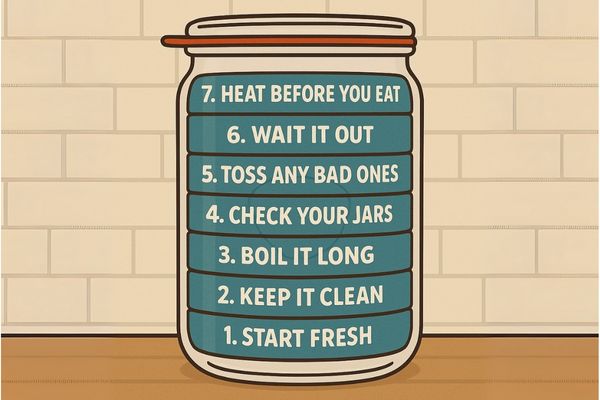
These elements, taken together, are what make the method work:
- Fresh, clean ingredients: It always begins with high-quality, intact, and fresh ingredients – whether fruits, vegetables, or meat. No bruises, rot, or visible spoilage. For root vegetables, the parts that grew underground are peeled and discarded. Everything is washed thoroughly. This upfront care helps reduce the number of spores from the start, which is an important part of keeping the risk low.
- Clean jars and a clean workspace: While it’s not sterile like a lab, the principle is the same: avoid introducing new contaminants. Jars stored in a basement might have traces of mold or mildew on them, so they’re cleaned thoroughly before use. Hands are washed. Work surfaces are wiped down. And we don’t lick the spoon and put it back in the pot (a habit that’s surprisingly hard to break, by the way, but part of working cleanly).
- Long boiling times (sometimes followed by a second processing step): The times I use come from recommendations shared in German canning forums, not just from the Weck books. I tend to follow the longer versions – not because I don’t trust the method, but because I don’t want to waste my effort canning food that might spoil. Many experienced canners feel the same.
Many people believe C. botulinum spores can’t be destroyed by boiling, but that’s not true. Learn why in my post: The boiling point myth – why you don’t need a pressure canner to kill Clostridium botulinum spores. C. botulinum spores can be inactivated at boiling temperature. It takes time. That’s the purpose of these extended boiling times.
Some German canners also add a second processing step – Tyndallization – 12 to 24 hours after the first boil, to catch any spores that may have survived. The BfR recommends it; most German home canners skip it. (More on the spectrum of German positions here: German Home Canning Rules: BfR Guidelines & Tyndallization.) - Diligent post-canning checks: We inspect every jar after 12–24 hours, once it has cooled completely and the vacuum has formed. At that point, we remove the clips and store the jars without them. If a vacuum breaks later, we’ll notice it. These checks aren’t because we’re afraid something went wrong – they’re smart practice. And I’m sure it’s much less disgusting to catch spoilage early than when you’re about to eat what’s inside.
- Immediate disposal of anything spoiled: Discard without tasting if you see any of these – a lid that comes off on its own, a metal lid bulging upward, active bubbling inside the jar, contents that spurt out when the jar is opened, mold or film on the surface, or an off smell. Smell alone is enough. The Group I Clostridium botulinum strains relevant to home canning break down proteins and generate gas as they grow – which is exactly why bulging, broken seals, and bad smells exist as warnings. A jar that unseals isn’t a failure; it’s a successful warning, doing the job the system asks it to do. No exceptions, ever. Period.
- Waiting periods before consumption: Traditional advice recommends waiting a while – anywhere from two to six weeks, depending on who you ask – before eating low-acid foods. This observation period adds another layer of safety. If something went wrong and spores were present, this window gives them time to germinate, start growing, and become obvious. There is an early phase where the bacteria are growing but no visible signs have appeared yet, and the toxin can already be at dangerous levels. It’s extremely potent, so I take this seriously. I’m not sure how many people follow the waiting period, but I do – and it makes me feel more comfortable with the system.
- Reheating before eating: Especially if the waiting period hasn’t passed yet – or if there’s any other reason to have a doubt. Botulinum toxin is heat-sensitive: bringing food to a boil destroys any toxin that might be present and makes the food safe to eat. If there are visible signs of spoilage, we throw it out – no exceptions. We don’t “heat and eat.” I think that bears repeating.
Each of these practices matters. But it’s their combination that really gives the method its strength. If you’re curious how I put these layers into practice, I explain my full process in this post: How I actually can food at home – base protocol for water bath canning
Trust wasn’t instant. It was earned.
It was scary at first. I come from a culture where botulism is the first thing people think about when they hear ‘home canning’ – and the USDA’s message is so absolute, so categorical, that stepping outside it felt dangerous.
But the more I learned, the more confidence I gained. I haven’t been doing this for decades (yet), but so far, I’ve had no spoilage in my low-acid jars.
What gives me the most reassurance, though, is the community. In the German online canning communities, I’m not relying on one person’s advice – I’m watching hundreds of people ask questions, share experience, and correct misinformation. It’s self-correcting.
An informal formal method – refined by a million quiet experiments
At this point, I don’t see the German method as anecdotal at all. I see it as a decentralized protocol, passed down and refined through practice. There’s no single enforced rulebook. Germany’s Federal Institute for Risk Assessment (BfR) publishes guidance, but it isn’t law, and many German home canners don’t know it exists. What governs the practice is community standard, hard-won, over generations.
When I look at the layered structure underneath, I recognize it. In the food industry it’s called HACCP (Hazard Analysis Critical Control Points). It’s the framework that designs barriers and control points into every safety-critical food process. A reader on one of my videos, who works in food manufacturing, named the connection unprompted: “Your hurdle analogy is what we’d call barriers or control points as part of a HACCP food safety management process.”
That recognition matters. The German method isn’t an alternative to professional safety thinking. It’s the same thinking, applied at a kitchen scale.
I noticed the pattern because of where I came from. My research career was three compounding stages of safety doctrine. Cell culture work, where a single contamination could set back months of research. Then virology drug discovery with live infectious agents, where mistakes meant making yourself or your colleagues sick. Then a national lab, where the operating principle was all accidents are preventable, all the time, without exception.
Redundant safety wasn’t paranoia in those settings. It was competence. So when I started reading my way into German canning communities and saw practiced, layered care being executed as a matter of course, I understood the pattern before I trusted it.
After more than a century of use, the absence of significant botulism outbreaks counts for something. The 2025 Weck book (Das Original Einkochbuch) even says: “In over 120 years of WECK history, no case of botulism has become known in connection with canning according to the WECK method.”
This isn’t luck. It’s a layered system – practiced, refined, and trusted for generations, without a single known case. That’s worth paying attention to.
A safe way – even if it’s not their way
I’m not here to convert anyone to German-style water bath canning. But I do want to show why it makes sense, why it works, and why it deserves recognition as a safe, thoughtful method.
I feel safe using this method because I understand how it works and what each step is designed to do. And I’ve seen it work. Not just in my own kitchen, but over and over again in canning forums, videos, and community conversations. The people practicing it take it seriously. They follow clear procedures and treat it like a system.
Much of what I’ve learned comes from private forums and community exchanges, and I want that knowledge to be easier to find. For anyone new to canning or curious about how the German method works, I hope this offers not just a how, but a why. Community knowledge shouldn’t stay hidden. It belongs in the public conversation: visible, accessible, and valued. That’s one of the reasons I decided to start this blog on German water bath canning.
I’ve learned there’s more than one safe way to can food at home. This German canning method isn’t USDA-recommended, but it’s built on layers of practical safety and refined through more than a century of use.
For a broader introduction to the method and why it works, see What you need to know about German water bath canning.
Frequently asked questions
The German method is widely used in Germany and has been refined over more than a century of practice. When followed carefully, it relies on multiple overlapping safety steps – including long boiling times, post-canning checks, and waiting periods – to keep low-acid foods like vegetables, soups, and meats shelf-stable.
Some people do, some don’t. But the strength of the system comes from layering. Even if one part isn’t perfect, the others can help catch problems. For example, if a jar doesn’t seal properly, it’s usually caught during vacuum checks or shows signs of spoilage during the waiting period. That’s the power of redundancy.
Reheating to a boil is one of the easiest and most effective ways to make sure your low-acid, home-canned foods are safe to eat. The botulinum toxin is heat-sensitive and readily inactivates when the food is brought to a boil. If any toxin is present, heating thoroughly will destroy it. That makes reheating a simple and reliable final safeguard. Some people reheat everything as a precaution. Some never reheat. Personally, I reheat most of my low-acid foods because they taste better hot, but in the cases where I don’t, I make sure all other safety checks are in place: a proper seal, no visible spoilage, and a long enough waiting period before opening the jar.
Not a single hot kill step. A system of overlapping safety layers, where each one independently reduces risk and the redundancy does the rest. The German Einkochen method uses seven: clean ingredients, clean jars and workspace, 90 to 120 minutes at 100°C, seal verification after 24 hours, immediate disposal of anything that shows a spoilage sign, a waiting period of 2 to 6 weeks before eating, and reheating to a boil before serving. Each layer interrupts the Clostridium botulinum risk pathway at a different point. The strength is the redundancy. If one layer is imperfect, the others catch what it missed.
That is exactly what the system is designed for. If a vacuum doesn’t form, the post-canning seal check catches it. If a boiling time was a few minutes short, the waiting period gives any surviving spores time to germinate and produce visible spoilage signs. If something slips past those, the pre-consumption boil destroys any toxin that may have formed. No single layer carries the whole load – which is the point. The reliability comes from the redundancy, not from any one step being perfect.
No. The seven layers are my analytical synthesis – my way of describing what makes the German method work as a system. You won’t find a German canning book that lists them this way. What you will find is the practices themselves – clean inputs, long boiling times, careful seal checks, waiting periods, reheating – woven through Weck books, BfR guidance, German canning forums, and a century of household practice. Naming them as layers makes the structure visible.
Free 7-lesson course + newsletter
Canning Science Foundations
Seven short lessons on the biology behind home canning: why the rules exist, what actually keeps food safe, and how to look at any recipe and see where the safety lives (no chemistry degree required). Finish them and you stay on for the newsletter: seasonal harvests, kitchen experiments, and the science behind each one.

Julie Kaiser is a molecular biologist and science writer who has lived in Germany since 2011. She spent over a decade in virology and national security research labs before becoming a professional science writer. She came to German water bath canning the way scientists come to most things: by reading the primary sources and deciding the evidence held up. Old World Preserves is where she writes about what she’s learned and what she’s growing, cooking, and preserving in her Lower Rhine garden.