
Roasted Tomato & Meat Sauce – Preserved by Water Bath Canning
My Favorite Shelf-Stable Pasta Sauce (Made for Canning)
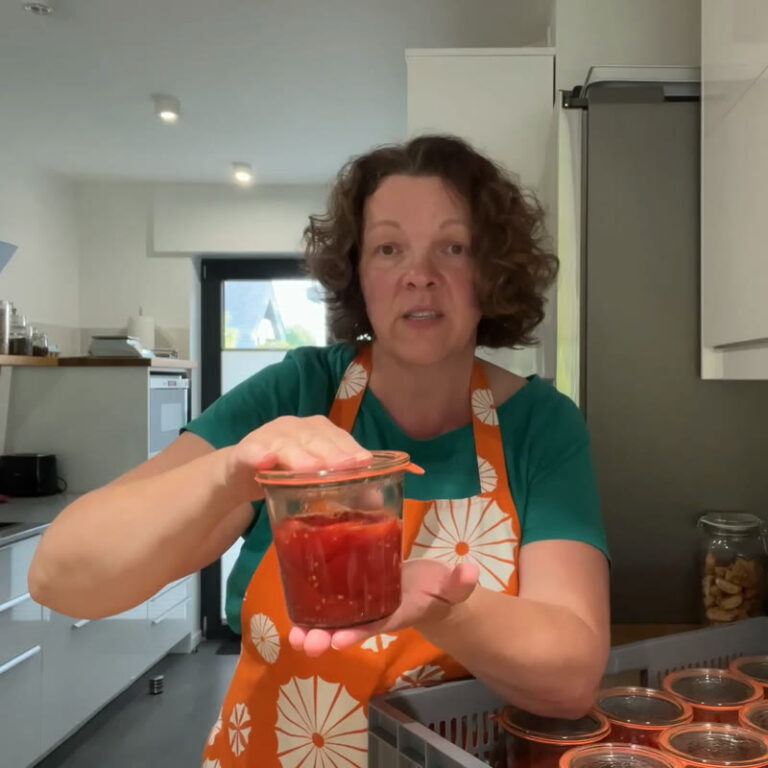
This tomato and meat sauce is a pantry staple in our house, made with oven-roasted tomatoes, deeply caramelized onions, and a blend of ground beef and pork for rich, layered flavor that tastes like you simmered it all day. It’s designed specifically for safe water bath canning, following traditional German methods, so you can store it at room temperature and enjoy it all year long.
You’ll notice the herb quantities are intentionally conservative. That’s because the flavor of canned foods continues to develop over time, and too many herbs (or the wrong kind – like parsley) can leave bitter notes after a few months. I’ve also included a trusted vegan broth powder that gives depth without introducing ingredients that might affect shelf stability. If you’re not sure your broth mix is safe for canning, leave it out and add it when reheating.
Curious which ingredients to avoid when preserving ready-to-eat meals? I’m writing a separate post all about that – link coming soon.
A Note on Preservation Method
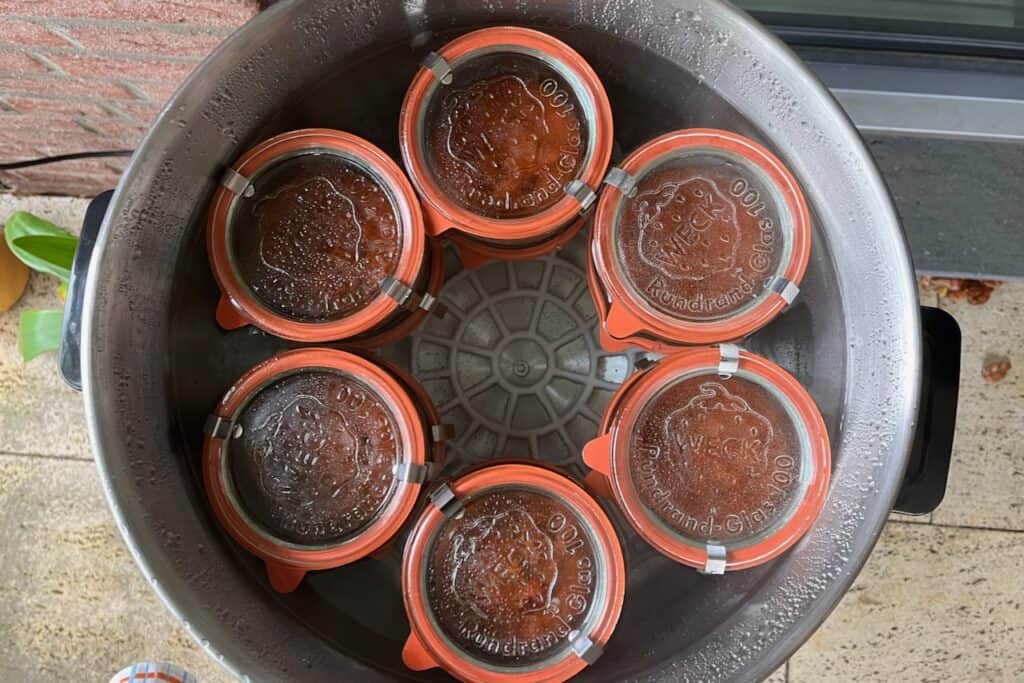
This recipe uses the traditional German waterbath canning method (Einkochen) to make the soup shelf stable by processing the jars for 120 minutes at 100°C. If you’re new to canning, please check my other posts to make sure you have all the safety details in place.
Roasted Tomato & Meat Sauce
Ingredients
- 6.3 kg (~14 pounds) ripe tomatoes, halved (about 14 lb)
- 4 large onions (chopped)
- 1 tablespoon neutral oil
- 1.3 kg (~3 pounds) ground beef and/or pork (about 2¾ lb)
- 2 cloves elephant garlic (minced (or substitute 4 regular cloves))
- 650 g fresh tomatoes (about 22.9 oz / coarsely chopped)
- 1 tablespoon Maggi vegan broth powder (see note above)
- 1 tablespoon dried herbs de Provence
- 1 tablespoon fennel seeds (lightly crushed)
- 1 tablespoon salt (or more to taste)
- 1.5 teaspoons ground black pepper
Units: metric first, with a US equivalent in brackets. Weight-to-weight and temperature conversions are exact; volume equivalents for chopped or packed ingredients are approximate. The German headspace and the vinegar quantity are kept as measured (safety-load values).
Method
Part 1: Prepare the tomatoes
- Preheat your oven to 200°C (400°F).
- Wash and halve most of the tomatoes, leaving the cores in. Place cut side up on a large baking sheet or roasting pan – no oil, salt, or spices.Note: I leave out a few coarsely chopped tomatoes to add to the sauce near the end, for texture.
- Roast for 3–3.5 hours until deeply caramelized and reduced. Check on them after an hour or so and reduce the oven temperature if they start getting too brown. You want browning but not burning.
- Let them cool; then deglaze the pan with a bit of water to collect all the flavorful, caramelized bits.
- Transfer everything to a blender and purée thoroughly.
- Optional: Push the purée through a fine sieve to remove the seeds and any remaining skin pieces. You can skip this step if you prefer a more “rustic” texture, but I like a smoother sauce.
Part 2: Caramelize the onions and brown the meat
- In a large, heavy-bottomed pot, heat 1 tablespoon of oil and cook the chopped onions over medium-low heat until golden and sweet. I take my time with this step and properly caramelize the onions. You can also just cook until soft and translucent, but they won’t be as flavorful.
- Add the minced elephant garlic toward the end and cook until fragrant.
- In a separate pan, brown the ground meat.
Part 3: Combine everything and cook
- Add the following to the pot with the onions and garlic:· Strained roasted tomato purée· Browned ground meat· Crushed fennel· Herbs de Provence· Maggi Gekörnte Brühe Extra fein vegan (Grained Broth Extra Fine, vegan)· Salt· Pepper
- Stir well to combine.
- Add the 650 g of fresh, coarsely chopped tomatoes.
- Simmer gently until the chunks of tomato are tender and starting to break down.
Part 4: Preservation (German Water Bath Method)
- Fill: Ladle the hot sauce into clean jars, leaving appropriate headspace. This is a very thick sauce, so it needs ~3 cm (about 1¼ inch) headspace to prevent siphoning. Wipe rims and put on lids according to your jar type.Note: If you are not familiar with German water bath canning (which differs from US guidelines), please check my other posts to make sure you have all the safety details and procedures in place.
- Process: Place jars in a water bath canner. Process for 120 minutes at 100°C (212°F).
- Cool down: Once the processing time is up, turn off the heat but leave the jars in the water for 5 minutes. This lets the temperature stabilize and helps prevent siphoning when you remove them.
- Rest: Remove the jars carefully and place them in a non-drafty spot to cool completely undisturbed.
- Check seals: After at least 12 hours (and less than 24), remove the clamps or rings (depending on your jar type) and check your seals.If a jar didn't seal: You can reprocess it if it has been less than 24 hours, or store it in the fridge to eat within the next few days.
- How to Serve
- Open & Inspect: Open the jar and ensure there are no visual signs of spoilage.
- Boil: Pour into a pot and boil for 10 minutes. I actually pour the sauce over my cooked pasta with a bit of the past cooking water, and then boil gently for the 10 minutes. (This is an added safety practice for waterbath-canned, low-acid foods that will inactivate and destroy botulinum neurotoxin, in case it is present despite no spoilage signs.)
Keep reading
More from Recipes
Free 7-lesson course + newsletter
Canning Science Foundations
Seven short lessons on the biology behind home canning: why the rules exist, what actually keeps food safe, and how to look at any recipe and see where the safety lives (no chemistry degree required). Finish them and you stay on for the newsletter: seasonal harvests, kitchen experiments, and the science behind each one.

Julie Kaiser is a molecular biologist and science writer who has lived in Germany since 2011. She spent over a decade in virology and national security research labs before becoming a professional science writer. She came to German water bath canning the way scientists come to most things: by reading the primary sources and deciding the evidence held up. Old World Preserves is where she writes about what she’s learned and what she’s growing, cooking, and preserving in her Lower Rhine garden.