
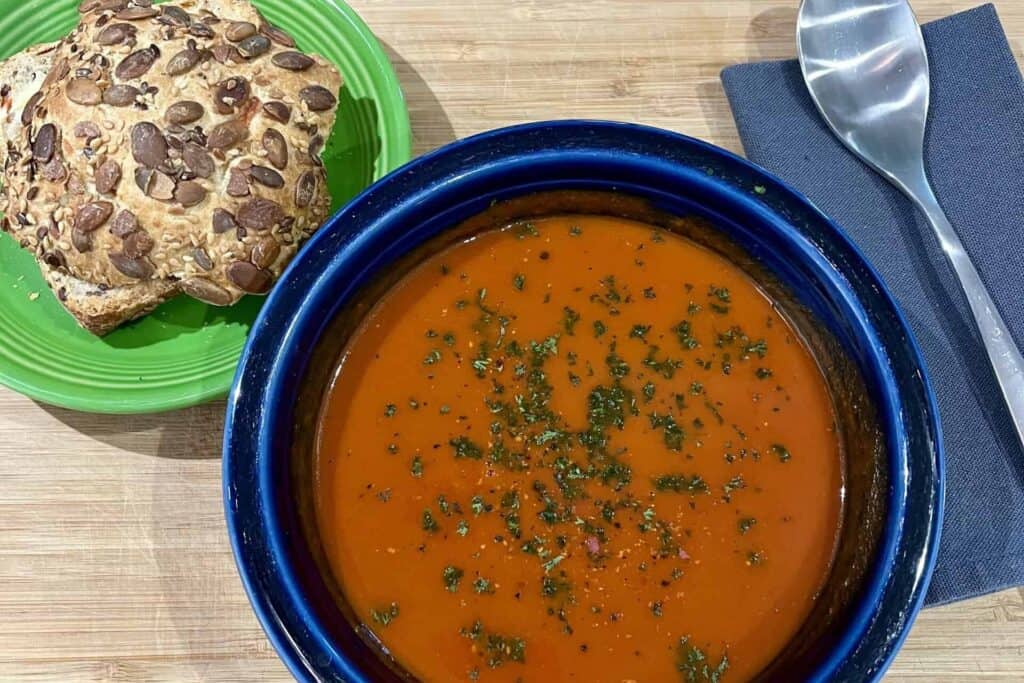
Roasted Red Pepper & Tomato Soup – Preserved by Water Bath Canning
Why This Roasted Red Pepper Soup is the Ultimate “Fast Food”
It’s easy to wonder, in the middle of a hot summer afternoon, if it’s really worth spending hours charring peppers on the grill and roasting trays of tomatoes until they are sweet and concentrated. But when January arrives and it’s cold, gray, and I need a lunch that tastes like pure sunshine – I know exactly why I did it.
This isn’t just a standard vegetable soup; it’s a flavor bomb. By roasting the produce down to less than half its volume, we caramelize the natural sugars and create a depth of flavor you simply can’t buy in a store.
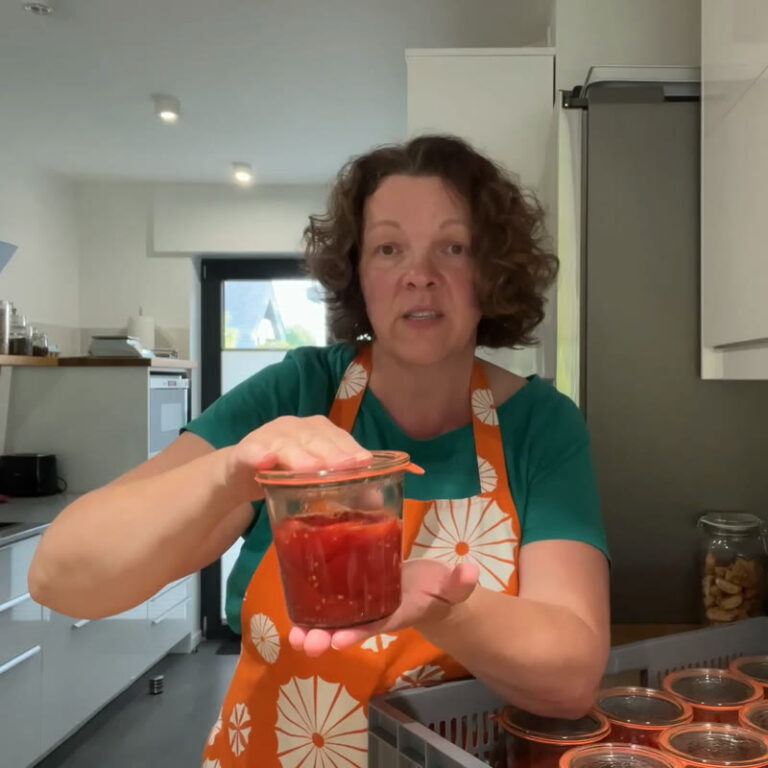
While many people associate canning with plain staples like green beans, this recipe proves that home food preservation can be gourmet. This is a “gift from the past” to your future self: a shelf-stable, velvety soup that is ready to be heated up, garnished with cream, and enjoyed in just 10 minutes.
A Note on Preservation Method
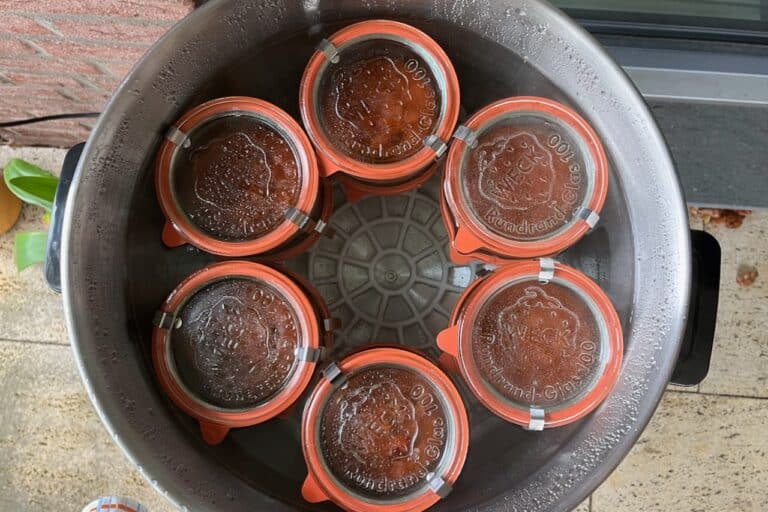
This recipe uses the traditional German waterbath canning method (Einkochen) to make the soup shelf stable by processing the jars for 120 minutes at 100°C. If you’re new to canning, please check my other posts to make sure you have all the safety details in place.
Roasted Red Pepper & Tomato Soup
Ingredients
- 7.2 kg (16 pounds) Tomatoes (about 15¾ lb / fresh or frozen/thawed)
- 4.7 kg (10.5 pounds) Red Bell Peppers (about 10¼ lb)
- 350 g Onions (about 12.3 oz / peeled/chopped)
- 2 Large Elephant Garlic cloves (or 1 head regular garlic)
- 300 g Tomato Paste (about 10.6 oz / optional, for more tomato flavor)
- Water or juice from the frozen tomatoes (for thinning)
- Seasonings: Garlic powder (Salt)
- 1.5 kg (~3.5 pounds) Tomatoes (about 3¼ lb / fresh or frozen/thawed)
- 1 kg (~2.2 pounds) Red Bell Peppers (about 2¼ lb)
- 1 Large Onion (peeled/chopped)
- 1 Large Elephant Garlic clove (or 2 cloves regular garlic)
- 60 g 4 tablespoons Tomato Paste (about 2.1 oz / optional, for more tomato flavor)
- Water or juice from the frozen tomatoes (for thinning)
- Seasonings: Garlic powder (Salt)
Units: metric first, with a US equivalent in brackets. Weight-to-weight and temperature conversions are exact; volume equivalents for chopped or packed ingredients are approximate. The German headspace and the vinegar quantity are kept as measured (safety-load values).
Method
Part 1: Roast and Char
- Roast: Preheat your oven to 200°C (400°F). Place the tomatoes, onions, and garlic in a big roasting pan. Roast until the vegetables are soft, sweet, and concentrated.
- Deglaze: Don't lose the best part! When you take the tomatoes out of the oven, check the pan for brown, caramelized bits stuck to the bottom. This is pure flavor. Pour a little water or tomato juice onto the hot baking sheet to 'deglaze' it, scrape up all those sticky bits, and combine that liquid with everything else.
- Char: While the tomatoes are roasting, char the bell peppers on a grill until they are blackened on all sides.
- Steam: Place the hot, charred peppers into a big bowl and cover it tightly. Let them steam and soften completely.
- Peel: Once they are cool to the touch, remove the charred peels, seeds, and cores.
Part 2: Puree and Strain
- Blend: Combine the roasted tomato mixture, the peppers, and the tomato paste in a high-speed blender. Note: The mixture will be very thick. Add some reserved tomato juice (if you started with frozen tomatoes) or a splash of water to help the blender process the mixture completely and evenly.
- Strain: Run this puree through a strainer to remove larger pieces of seeds and skins.Tip: I use a standard wire mesh strainer and a round metal ladle to push the puree through quickly.
- Dilute & Season: Add water to the strained puree until it reaches a proper soup consistency. Season to taste with salt, garlic powder, and pepper.
Part 3: Preservation (German Water Bath Method)
- Fill: Fill your clean canning jars with the soup, leaving 2 cm (about ¾ inch) of headspace.Note: If you are not familiar with German water bath canning (which differs from US guidelines), please check my other posts to make sure you have all the safety details and procedures in place.
- Process: Place jars in a water bath canner. Process for 120 minutes at 100°C (212°F).
- Cool Down: Once the processing time is up, turn off the heat but leave the jars in the water for 5 minutes. This lets the temperature stabilize and helps prevent siphoning when you remove them.
- Rest: Remove the jars carefully and place them in a non-drafty spot to cool completely undisturbed.
- Check Seals: After at least 12 hours (and less than 24), remove the clamps or rings (depending on your jar type) and check your seals.If a jar didn't seal: You can reprocess it if it has been less than 24 hours, or store it in the fridge to eat within the next few days.
How to Serve
- Open & Inspect: Open the jar and ensure there are no visual signs of spoilage.
- Boil: Pour the soup into a pot and boil hard for 10 minutes. (This is a standard safety practice for this type of canning).
- Balance the Flavor: Roasted peppers can sometimes bring a bitter note, so taste your soup and balance this if needed by playing with sweet, salty, and sour elements:Creaminess: I like to add a splash of heavy cream to smooth out the flavor.Acidity: A dash of balsamic vinegar can add depth and sweetness.Too Sour? If the tomatoes made the soup too acidic, add a tiny pinch of baking soda to neutralize it.
Keep reading
More from Recipes
Free 7-lesson course + newsletter
Canning Science Foundations
Seven short lessons on the biology behind home canning: why the rules exist, what actually keeps food safe, and how to look at any recipe and see where the safety lives (no chemistry degree required). Finish them and you stay on for the newsletter: seasonal harvests, kitchen experiments, and the science behind each one.

Julie Kaiser is a molecular biologist and science writer who has lived in Germany since 2011. She spent over a decade in virology and national security research labs before becoming a professional science writer. She came to German water bath canning the way scientists come to most things: by reading the primary sources and deciding the evidence held up. Old World Preserves is where she writes about what she’s learned and what she’s growing, cooking, and preserving in her Lower Rhine garden.